Inverse Of Matrix
In linear algebra, matrix inverse holds a special place because there is no division in matrix algebra. You cannot divide two matrices. Fortunately, the division is possible when a matrix is multiplied with its inverse which is unique.
The inverse is not possible with just any kind of matrix, a matrix must be square and invertible and the reasons are explained in this article along with several identities and examples involving inverse matrices.
An inverse matrix can also be used for finding the solution for system of linear equations, that is,  where
where  is augmented matrix,
  is the solution vector and
  is the constant vector.
What Is The Need For Inverse?
Inverse means opposite of some operation performed and the result obtained is identity of that operation.
For example,
Additive Identity
If  then
then  is additive identity.

But,
 (additive identity).
Therefore, subtraction is inverse operation of addition.
Multiplicative Identity
If  then
then  is multiplicative identity because it gives
  as result.

But,
 ( multiplicative identity).
Therefore, multiplying with reciprocal or division is inverse operation of multiplication.
The same idea can be extended to matrix since we are unable to divide two matrices directly. If is a square matrix and invertible , then find an inverse matrix  such that multiplying it with will give an identity matrix
  of same order.
\begin{aligned}
A.A^{-1} = A^{-1}.A = I
\end{aligned}
For example,
Let be a square matrix of order 2 x 2. The inverse of matrix is .
\begin{aligned}
&A = \begin{bmatrix} 2 & 1\\ 2 & 6\end{bmatrix}
\end{aligned}
Computer the determinant.
\begin{aligned}
&Det(A) = 2\times 6 - 1 \times 2 = 12 - 2 = 10
\end{aligned}
Add negative to following elements in matrix .
\begin{aligned}
A = \begin{bmatrix} 2 & 1\\ 2 & 6\end{bmatrix} = \begin{bmatrix} + & -\\ - & +\end{bmatrix} = \begin{bmatrix} 2 & -1\\ -2 & 6\end{bmatrix}
\end{aligned}
Swap positive entries.
\begin{aligned}
&\begin{bmatrix} 2 & -1\\ -2 & 6\end{bmatrix} = \begin{bmatrix} 6 & -1\\ -2 & 2\end{bmatrix}
\end{aligned}
Multiply the above result with  .
.
\begin{aligned}
&A^{-1} = \frac{1}{10}\begin{bmatrix} 6 & -1\\ -2 & 2\end{bmatrix}\\\\
&= \begin{bmatrix} 3/5 & -1/10\\-1/5 & -1/5\end{bmatrix}
\end{aligned}
Let us now verify whether  .
.
\begin{aligned}
&\begin{bmatrix} 2 & 1\\ 2 & 6\end{bmatrix} \times \begin{bmatrix} 3/5 & -1/10\\ -1/5 & -1/5\end{bmatrix}\\\\
&= \begin{bmatrix} 6/5 - 1/5 & -1/5+ 1/5\\ 6/5 - 6/5& -1/5+ 6/5\end{bmatrix}\\\\
&= \begin{bmatrix} 1 & 0\\ 0 & 1\end{bmatrix}
\end{aligned}
Why Square Matrix ?
The inverse deals with negative power such as , a non-square matrix is cannot be used because it is undefined( cannot multiply).
The second reason for using square matrix is the identity matrix. An identity matrix is a square matrix only. A product of non-square matrix with its inverse will not result in an identity matrix.
If a square matrix has inverse matrix  such that
\begin{aligned}
&AB = BA = I
\end{aligned}
Then the matrix is called invertible matrix and matrix is its inverse. If there is no for matrix , then it is called Singular matrix.
A matrix is singular and has no inverse if its determinant is 0. You will learn about determinants in future lessons.
Suppose is a singular matrix of order 2 x 2.
\begin{aligned}
&A = \begin{bmatrix}a & b\\c & d\end{bmatrix}\\\\
&ad - bc = 0
\end{aligned}
In the same manner, determinants of higher order matrices is found.
Therefore, only square matrix is used to find inverse which is also a square matrix of size  .
.
Uniqueness Of Inverse Matrix
If a square matrix is invertible, then it has exactly one inverse.
Proof :
Suppose that there are two inverse and  for matrix . We get
\begin{aligned}
&AB = BA = I - (1)\\\\
&AC = CA = I - (2)
\end{aligned}
We know that any matrix multiplied by Identity matrix will result itself. Therefore, the following is true.
\begin{aligned}
&B = B.I\\\\
&B = B(AC)  \hspace{5px}by  \hspace{5px}(2)\\\\
&B = (BA)C   \hspace{5px}by  \hspace{5px}associativity  \hspace{5px}property\\\\
&B = I.C   \hspace{5px}by  \hspace{5px}(1)\\\\
&B = C\\\\
\end{aligned}
Use Of Inverse Matrix
The purpose of using matrix is to solve for  where represents the augmented matrix obtained from the system of linear equations, is the vector of unknowns or solution vector and is the constant vector.
\begin{aligned}
A.x = b => \begin{bmatrix}a & b\\c & d\end{bmatrix}.\begin{bmatrix}x \\ y\end{bmatrix} = \begin{bmatrix}b_1 \\ b_2\end{bmatrix}
\end{aligned}
Multiply both sides by . Note that the order of operation is important.
\begin{aligned}
&(A^{-1}A)x = A^{-1}b\\\\
&By \hspace{5px} A^{-1}A = AA^{-1} = I, \hspace{5px}we\hspace{5px} get \\\\
&Ix = A^{-1}b => x = A^{-1}b\\\\
\end{aligned}
Let us try to solve a system of equation using above result where matrix is invertible and square. Suppose the system of equations have following equation.
\begin{aligned}
&2x + 4y = 10\\\\
&3x + 2y = 7
\end{aligned}
Let be a square and invertible augmented matrix of order 2 x 2 derived from the system of equations above. Therefore, is as follows.
\begin{aligned}
&A.x = b\\\\
&\begin{bmatrix}2 & 4\\3 & 2\end{bmatrix} . \begin{bmatrix}x \\ y\end{bmatrix} = \begin{bmatrix}10 \\ 7\end{bmatrix}
\end{aligned}
Let us find the inverse of matrix . But, first we must find the determinant of matrix .
\begin{aligned}
Det(A) = ad - bc = 4 - 12 = -8
\end{aligned}
Change the sign and swap the positive entries. Then multiply it with  to get the inverse of matrix .
\begin{aligned}
\begin{bmatrix}2 & 4\\3 & 2\end{bmatrix} = \begin{bmatrix}+ & -\\- & +\end{bmatrix} = \begin{bmatrix}2 & -4\\-3 & 2\end{bmatrix}\\\\

\end{aligned}
Swap the positive entries.
\begin{aligned}
&\begin{bmatrix}2 & -4\\-3 & 2\end{bmatrix} = \begin{bmatrix}2 & -4\\-3 & 2\end{bmatrix}\\\\
\end{aligned}
Multiply with  .
.
\begin{aligned} &= \frac{ 1}{-8} \times \begin{bmatrix}2 & -4\\-3 & 2\end{bmatrix}\\\\
&A^{-1} = \begin{bmatrix}-1/4& 1/2\\3/8 & -1/4\end{bmatrix}
\end{aligned}
We need to verify if this is correct inverse .
\begin{aligned}
&A = \begin{bmatrix}-1/4& 1/2\\3/8&-1/4\end{bmatrix} . \begin{bmatrix}2 & 4\\3 & 2\end{bmatrix}= I\\\\
&= \begin{bmatrix}1/2+ 3/2& -1 + 1\\3/4+ (-3/4 )& 3/2+ (-1/2)\end{bmatrix}\\\\
&= \begin{bmatrix}1 & 0\\0 & 1\end{bmatrix}
\end{aligned}
The inverse is correct and compute the value of solution vector using  in the same order.
x = A^{-1}. bWhere,
A^{-1} = \begin{bmatrix}-1/4 & 1/2\\3/8 & -1/4\end{bmatrix} \hspace{4px} b = \begin{bmatrix}10 \\ 7\end{bmatrix}Where,
\begin{aligned}
&A^{-1} = \begin{bmatrix}-1/4 & 1/2 \\ 3/8 & -1/4\end{bmatrix} \hspace{5px} b = \begin{bmatrix}10 \\ 7\end{bmatrix}\\\\
&x = \begin{bmatrix}-10/4+ 7/2\\ 30/8+ (-7/ 4) \end{bmatrix}\\\\
&x = \begin{bmatrix}-5/2+7/2\\15/4+(-7/4)\end{bmatrix}\\\\
&x = \begin{bmatrix}1 \\ 2\end{bmatrix}
\end{aligned}
We must verify the solution by substitution in the system of linear equations.
\begin{aligned}
&2(1) + 4(2) = 10\\\\
&3(1) + 2(2) = 7
\end{aligned}
Similarly, we can verify some other interesting results in the following section.
Other Interesting Results
In this section, we will verify some other interesting results concerning inverse matrices.
(a) Product of two or more invertible matrices are invertible matrix.
\begin{aligned}\
(AB)^{-1} = B^-1A^{-1} \hspace{5px} //order \hspace{5px}is \hspace{5px}important
\end{aligned}Proof:
Let and be two invertible matrices of order . Then  . If matrix
  is invertible, then its inverse is
  .
.
Therefore,
\begin{aligned}
&PP^{-1} = P^{-1}P = I_n\\\\
&(AB)(B^{-1}A^{-1})\\\\
&= A(BB^{-1})A^{-1} \hspace{5px} //because \hspace{4px}AA^{-1}=I_n\\\\
&= I_nAA^{-1}\\\\
&= I_n
\end{aligned}
Example #1
Let and be  invertible matrix.
\begin{aligned}
&A = \begin{bmatrix} 1 & 5\\0 & 9\end{bmatrix} \hspace{5px}B = \begin{bmatrix}2 & 1\\3 & 4\end{bmatrix}
\end{aligned}
Let  then,
then,
\begin{aligned}
&C = \begin{bmatrix} 1 & 5\\0 & 9\end{bmatrix}\times \begin{bmatrix}2 & 1\\3 & 4\end{bmatrix}\\\\
&C = \begin{bmatrix}2 + 15 & 1+20 \\0 + 27 & 0 + 36\end{bmatrix}\\\\
&C = \begin{bmatrix}17 & 21\\ 27 & 36\end{bmatrix}\\\\
&
\end{aligned}
We will now find the inverse of the product matrix , that is,  . First compute the determinant of matrix.
Det(C) = 17\times36 - 21\times27 = 612 - 567 = 45
Now change value of element  and
and  to negative in matrix . Then swap the remaining positive values. Multiply the resultant matrix with
  .
.
\begin{aligned}
&C^{-1} = 1/45 \times \begin{bmatrix}36 & -21\\-27&17\end{bmatrix}\\\\
&C^{-1}= \begin{bmatrix}36/45 &  -21/45 \\ -27/45 &17/45\end{bmatrix}\\\\
&C^{-1}= \begin{bmatrix}36/45 & -21/45\\-27/45&17/45\end{bmatrix}
\end{aligned}
We must find the product matrix  .
.
\begin{aligned}
&B^{-1} = \begin{bmatrix}4/5 & -1/5\\ -3/5& 2/5\end{bmatrix}\\\\
&A^{-1} = \begin{bmatrix}1 & -5/9\\ 0 & 1/9\end{bmatrix}\\\\
&B^{-1} \cdot A^{-1} = \begin{bmatrix}4/5 & -1/5\\ -3/5 & 2/5\end{bmatrix} \times \begin{bmatrix}1 & -5/9\\ 0 &1/9\end{bmatrix}\\\\
&B^{-1} \cdot A^{-1} = \begin{bmatrix}4/5 + 0 & -20/45 + -1/45\\ -3/5+0 & 15/45+2/45\end{bmatrix}\\\\
&B^{-1}.A^{-1} = \begin{bmatrix}4/5&-7/15\\ -3/5& 17/45\end{bmatrix}
\end{aligned}
Therefore,  .
.
(b) Inverse of inverse matrix is the original matrix.
Let be a  invertible matrix. Let
  . Therefore, inverse of matrix is the matrix where
  .
.
We know that  .
.
\begin{aligned}
\begin{bmatrix}a\end{bmatrix} \times \begin{bmatrix}1/a\end{bmatrix} = \begin{bmatrix}1\end{bmatrix}
\end{aligned}
Therefore,
\begin{aligned}
&(A^{-1})^{-1} = (\begin{bmatrix}1/a\end{bmatrix})^{-1}\\\\
&= (\begin{bmatrix}1/a\end{bmatrix})^{-1} = \begin{bmatrix}a\end{bmatrix}\\\\
&= \begin{bmatrix}a\end{bmatrix}= A\\\\
&(A^{-1})^{-1} = A
\end{aligned}
Example #2
Let be a invertible matrix.
A = \begin{bmatrix}1 & 2\\ 3 & 9\end{bmatrix}The inverse of the matrix is
\begin{aligned}
A^{-1} = \begin{bmatrix}3 &-2/3\\-1 &1/3\end{bmatrix}
\end{aligned}
Let us take inverse of inverse matrix A^{-1}.
\begin{aligned}
Det(A^{-1}) = 1 - 2/3 = 1/3
\end{aligned}
Change signs and swap positive values in .
\begin{aligned}
= \begin{bmatrix}1/3&2/3\\1 & 3\end{bmatrix}
\end{aligned}
Multily above result with  .
.
\begin{aligned}
&(A^{-1})^{-1} = 3 \times \begin{bmatrix}1/3& 2/3\\1 & 3\end{bmatrix}\\\\
&(A^{-1})^{-1} = \begin{bmatrix}1 & 2 \\3 & 9\end{bmatrix}= A\\\\
\end{aligned}
Therefore, 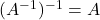 .
.
(c) If non-negative power of a invertible square matrix is  , then negative power of invertible square matrix is
A^{-n} = A^{-1}.A^{-1}.A^{-1}.A^{-1}(n-times)Example #3
Let be a invertible square matrix of order . Let  be a positive integer.
\begin{aligned}
&A^3 = \begin{bmatrix}2 & 3 \\ 1 & 5\end{bmatrix} \times \begin{bmatrix}2 & 3 \\ 1 & 5\end{bmatrix} \times \begin{bmatrix}2 & 3 \\ 1 & 5\end{bmatrix}\\\\
&A^3 = \begin{bmatrix}35 & 126 \\ 42 & 161\end{bmatrix}
\end{aligned}
Let be the inverse matrix for A.
\begin{aligned}
&A^{-1} = \begin{bmatrix}5/7& -3/7\\ -1/ 7& 2/7\end{bmatrix}\\\\
&A^{-3} = \begin{bmatrix}23/49& -18/49\\  -6/49&5/49\end{bmatrix}
\end{aligned}
But we know that  .
.
A^3A^{-3} = A^{3-3} = A^0 = I\begin{aligned}
&A^3A^{-3} = \begin{bmatrix}35 & 126 \\ 42 & 161\end{bmatrix} \times \begin{bmatrix}23/49& -18/49\\-6/49&5/49\end{bmatrix}\\\\
&A^3A^{-3} = \begin{bmatrix}1 & 0 \\ 0 & 1\end{bmatrix} = I
\end{aligned}Therefore,  .
.
(d) If  is a non-zero scalar and
  is invertible square matrix, then
kA = 1/kA^{-1}Proof:
We know that  and also following algebraic identities applies in the case of matrix multiplication with scalars.
\begin{aligned}
&a(bP) = abP (1)\\\\
&aP(Q) = P(aQ)  (2)\\\\
&
where and  are defined matrices. Using equation
  we get
\begin{aligned}
(kA)\left(1/k\right) \cdot A^{-1}= I
\end{aligned}
Using equation (2)
\begin{aligned}
&1/k \cdot k(A)(A^{-1})= I\\\\
&1/k \cdot k \cdot I = I\\\\
&(1) . I = I
\end{aligned}
Therefore,  is true.
Example #4
Let  and matrix is invertible and order 2 x 2.
A = \begin{bmatrix}3 & 1 \\4 & 2\end{bmatrix} \hspace{5px} A^{-1} = \begin{bmatrix}1 & -1/2 \\-2 & 3/2\end{bmatrix}Multiply with matrix and take inverse.
kA = 2 \times \begin{bmatrix}3 & 1 \\4 & 2\end{bmatrix} = \begin{bmatrix}6 & 2 \\8 & 4\end{bmatrix} Take determinant of the matrix .
Det(A) = 6 \times 4 - 8 \times 2 = 24 - 16 = 8
Let and matrix is invertible and order 2 x 2.
\begin{aligned}
A = \begin{bmatrix}3 & 1 \\4 & 2\end{bmatrix} \hspace{5px} A^{-1} = \begin{bmatrix}1 & -1/2 \\-2 & 3/2\end{bmatrix}
\end{aligned}
Multiply with matrix and take inverse.
kA = 2 \times \begin{bmatrix}3 & 1 \\4 & 2\end{bmatrix} = \begin{bmatrix}6 & 2 \\8 & 4\end{bmatrix}Take determinant of the matrix .
Det(A) = 6 \times 4 - 8 \times 2 = 24 - 16 = 8
Take negative of and and swap positive values. Multiply with  .
.
\begin{aligned}
(kA)^{-1} = 1/ 8\times \begin{bmatrix}4 & -2 \\-8 & 6\end{bmatrix} = \begin{bmatrix}1/ 2 &-1/4 \\-1 & 3/4\end{bmatrix} \hspace{5px} (3)
\end{aligned}
We must compute the value of  .
.
\begin{aligned}
1/kA^{-1}= 1/2\times\begin{bmatrix}1 & -1/ 2\\-2 & 3/2\end{bmatrix} = \begin{bmatrix}1/2 & -1/4\\-1 & 3/4\end{bmatrix} \hspace{5px} (4)
\end{aligned}
(kA)^{-1} = 1/kA^{-1} \hspace{5px} (5)(e) If is an invertible matrix of order then the transpose  is also invertible and equal to transpose of inverse matrix .
\left(A^T\right)^{-1}= \left(A^{-1}\right)^{-1}Example #5
Let matrix of order .
A = \begin{bmatrix}1 & 2\\3 & 8\end{bmatrix} \hspace{5px} A^T = \begin{bmatrix}1 & 3\\2 & 8\end{bmatrix}Inverse of Transpose .
\left(A^T\right)^{-1} = 1/2 \times \begin{bmatrix}8 & -3\\-2 & 1 \end{bmatrix}= \begin{bmatrix}4 & -3/ 2\\-1 & 1/2\end{bmatrix}Transpose of Inverse .
\begin{aligned}
&A^{-1} = 1/2 \times \begin{bmatrix}8 & -2\\-3 & 1\end{bmatrix}\\\\
&\left(A^{-1}\right)^{T}= \begin{bmatrix}4 & -1\\ -3/ 2 & 1/2\end{bmatrix}^T\\\\
&\left(A^{-1}\right)^{T}= \begin{bmatrix}4 & -3/2\\-1 &1/2\end{bmatrix}
\end{aligned}
Therefore,  .
.
In this article, we explained why and what are inverse of matrix. Next, we discuss how to obtain inverse of small to large invertible matrices using different available methods.
Power Of Matrices
The matrices can be multiplied to get product matrix and also they demonstrate all other mathematical properties. The power of matrices is another mathematical property of matrix where matrix is raised to a power using an exponent. This brings another question, does the exponent laws applies to matrices or not ? what type of matrices qualifies to be raised to some power ? What about common mathematical identities that involve matrices and power of matrices.
Exponents or Power of a Number
Exponent or power is a number which tell us how many times a number  should multiplied by itself. If represents a base and
  is its power, then its written as
  which means

Similarly, a square matrix and an integer is given, then  power of is defined as product matrix obtained by multiplying by itself times.
A^n = A \times A \times A \times ... \times A \hspace{5px}(n \hspace{5px}times)Note that the matrix is
- a square matrix
- and
 is a product matrix of same order.
 is a product matrix of same order.
The exponents have their own algebra which is given as follows.
Basic Laws of Exponents
The basic laws of exponents applied to any real number  and these are




We need to find out whether these laws applies to square matrices or not. Let us verify this claim with examples.
Example Proof #1
Suppose is a square matrix of order 2 x 2.
\begin{aligned}
&A = \begin{bmatrix}1 & 2\\2 & 3\end{bmatrix}\\\\
&A^2 = \begin{bmatrix}1 & 2\\2 & 3\end{bmatrix} \times \begin{bmatrix}1 & 2\\2 & 3\end{bmatrix} = \begin{bmatrix}1+4 & 2+6\\2+6 & 4+9\end{bmatrix} = \begin{bmatrix}5 & 8\\8 & 13\end{bmatrix}\\\\
&A^3 = \begin{bmatrix}5 & 8\\8 & 13\end{bmatrix} \times \begin{bmatrix}1 & 2\\2 & 3\end{bmatrix} = \begin{bmatrix}5+16 & 10+24\\8+26 & 16+39\end{bmatrix} = \begin{bmatrix}21 & 34\\34 & 55\end{bmatrix}\\\\
&A^2 \times A^3 = A^{2 + 3} = A^{5}\\\\
&A^2 \times A^3 = \begin{bmatrix}5 & 8\\8 & 13\end{bmatrix} \times \begin{bmatrix}21 & 34\\34 & 55\end{bmatrix} = \begin{bmatrix}105+272 & 170+440\\168+442 & 272+715\end{bmatrix} = \begin{bmatrix}377 & 610\\610 & 987\end{bmatrix}\\\\
&
\end{aligned}
Also,
\begin{aligned}
&A^5 = \begin{bmatrix}377 & 610\\610 & 987\end{bmatrix}
\end{aligned}
Therefore, both side of the equation is equal.
Example Proof #2
There is not concept of division in matrix, however, you can divide element of matrix by multiplying it with an inverse value which is same as dividing the element. Inverse of a matrix is covered in the next lesson.
If is a square matrix of order 2 x 2. Then,
\begin{aligned}
A = \begin{bmatrix}1 & 2\\2 & 3\end{bmatrix}
\end{aligned}
Therefore,
 is not possible, but if is an invertible matrix then,
\begin{aligned}
A.A^{-1} = I
\end{aligned}
Where, is inverse of the matrix of same order and is called the identity matrix of same order.
Example Proof #3
The power of power of a matrix is a product matrix with exponents multiplied. If is a square matrix raised to power  and
and  is also raised to the power
  , then the resultant product matrix is
  of same order.
Let be a square matrix with order 2 x 2.
\begin{aligned}
A = \begin{bmatrix}1 & 2\\2 & 3\end{bmatrix}
\end{aligned}
Then,
\begin{aligned}
&(A^2)^3 = A^{2 \times 3} = A^6\\\\
&(A^2)^3 = \begin{bmatrix}5 & 8\\8 & 13\end{bmatrix}^3\\\\
&A^{2 \times 3} = \begin{bmatrix}5 & 8\\8 & 13\end{bmatrix} \times \begin{bmatrix}5 & 8\\8 & 13\end{bmatrix} \times \begin{bmatrix}5 & 8\\8 & 13\end{bmatrix}\\\\
&A^{2 \times 3} = \begin{bmatrix}89 & 144\\144 & 233\end{bmatrix} \times \begin{bmatrix}5 & 8\\8 & 13\end{bmatrix}\\\\
&A^{2 \times 3} = \begin{bmatrix}445 + 1152 & 712 + 1872\\720 + 1864 & 1152+3029\end{bmatrix}\\\\
&A^{2 \times 3} = \begin{bmatrix}1597 & 2584\\2584 & 4184\end{bmatrix}\\\\
&Also,\\\\
&A^6 = \begin{bmatrix}1597 & 2584\\2584 & 4184\end{bmatrix}
\end{aligned}
Example Proof #4
The product of defined matrices  raised to power is equal to product of powers of individual matrices and raised to the power .
\begin{aligned}
&(AB)^p = A^p \times B^p\\\\
\end{aligned}
We can rewrite the equation as
\begin{aligned}
&(AB)^p = (AB)(AB)(AB)... p-times\\\\
&(AB)^p = A(BA)(BA)B ... p-times
\end{aligned}
But we know that is not commutative.
\begin{aligned}
AB \ne BA
\end{aligned}
Therefore,
\begin{aligned}
(AB)^p \ne A^p \times B^p
\end{aligned}
Why Only Square Matrix ?
Only square matrix is suitable for exponents or to be raised to some powers because of two reasons.
- Non-Square or Singular matrices are not defined. If
 is a non-square matrix of order
  then
then  is not possible because
  where
where  is row and
  is column of matrix .
 - When we need to take inverse which is
 , the matrix must be a square. Singular matrices are not invertible.
 , the matrix must be a square. Singular matrices are not invertible.
Example Proof #5
Let be a non-square matrix with order  . Let be an non-negative integer whose value is 2.
\begin{aligned}
&A = \begin{bmatrix}1 & 4 & 2\\2 & 0 & 1\end{bmatrix}\\\\
\end{aligned}
Let us try to obtain  , then we observe that it is not possible.
 is undefined where
  and
and  . This is because
  required for multiplication of matrices.
Therefore, a matrix cannot be raised to power unless it is a square matrix.
Example Proof #6
Another reason to use square matrix with power is to find inverse matrix. If is a matrix that is invertible and we wish to find the inverse matrix such that
\begin{aligned}
A.A^{-1} = A^{-1}.A = I_{n \times n}
\end{aligned}
The  represents an identity matrix whose main diagonals are 1 and rest of the entries are 0. It is a square matrix. Therefore, and must be square matrices.
 square matrix.
In the next section, we will explore whether matrices complies with common algebraic identities or not.
Common Algebraic Identities And Square Matrices
The standard algebraic identities are true for any value of variables. Instead of numbers, we will use square matrix to prove these identities holds for matrices too.


Order Of Multiplication
In matrix multiplication, the order of multiplication is very important because  which is even true for square matrices.
If  , then any one of the following is true.
- The matrix
 .
. - Either or
 is identity matrix
  .
. - Either or is zero or null matrix
 .
. - The is inverse of or the matrix is inverse of .
 .
. .
.Let us now verify the common algebraic identities with matrices as variables.
Example Proof #7
We check the following identity :  .
.
Let and be square matrices of order 2 x 2.
\begin{aligned}
&(A + B)^2 = (A + B)(A + B)\\\\
&= A^2 + AB + BA + B^2
\end{aligned}
But , therefore,
 not possible.
Example Proof #8
We will verify the claim: 
Let and be square matrix of order 2 x 2.
\begin{aligned}
&A^2 - B^2 = (A + B)(A - B)\\\\
&
\end{aligned}
We can write the right-hand side as,
\begin{aligned}
&= A^2 - AB + BA - B^2
\end{aligned}
But we know that , therefore, above identity is false.
Example Proof #9
We check the identity:  .
.
Let and be square matrices of order 2 x 2. We multiply (A + B)^3, we get following results.
\begin{aligned}
&(A + B)(A + B)(A + B)
\end{aligned}
Since, we know that is not possible. Therefore,  is also false.
Example Proof #10
We now verify the identity : 
Let and be square matrices and single both are defined. We get following equation from $A^2B^2.
\begin{aligned}
&A^2B^2 = A.A.B.B
\end{aligned}
We get,
\begin{aligned}
A^2B^2 = A(A.B)B
\end{aligned}
Therefore, the identity is true because the order of multiplication is same.
Homogeneous System Of Linear Equations
So far you have learned about non-homogeneous system of linear equations of the form  where is the augmented matrix and is the matrix representing unknowns and is the result of the product. The homogeneous system of linear equations has all of its constant term set to zero.
Consider the following homogeneous system of linear equation.
\begin{aligned}
&A = \begin{bmatrix}2 & 4 \\1 & 3\end{bmatrix} X = \begin{bmatrix}x\\y\end{bmatrix} B = \begin{bmatrix}0\\0\end{bmatrix}\\\\

&A \cdot X = \begin{bmatrix}2 & 4 \\1 & 3\end{bmatrix} \cdot \begin{bmatrix}0\\0\end{bmatrix}= \begin{bmatrix}0\\0\end{bmatrix} = B
\end{aligned}
Consistent System
The homogeneous system of linear equations is a consistent with at least one solution. It is called the trivial solution. Let there be a homogeneous system of linear equations with two unknown variable.
\begin{aligned}
&2x + y = 0\\\\
&x + \frac{1}{2}y = 0
\end{aligned}
The system has solution when  and
and  .
.
\begin{aligned}
&2(0) + (0) = 0\\\\
&(0) + \frac{1}{2}(0) = 0
\end{aligned}
Therefore,  is a trivial solution to homogeneous system of linear equations.
Non-Trivial Solution To Homogeneous Equations
The homogeneous system is consistent so there are two possibilities.
- It has only trivial solution
- It has infinite many solutions including trivial solution.
Graphical Representation
Suppose there are two lines
\begin{aligned}
&a_1x + b_1y = 0\\\\
&a_2x + b_2y = 0
\end{aligned}
When two lines intersect at a single point there is only one unique solution. In the case of homogeneous linear equations the point of interaction is the origin  .
.
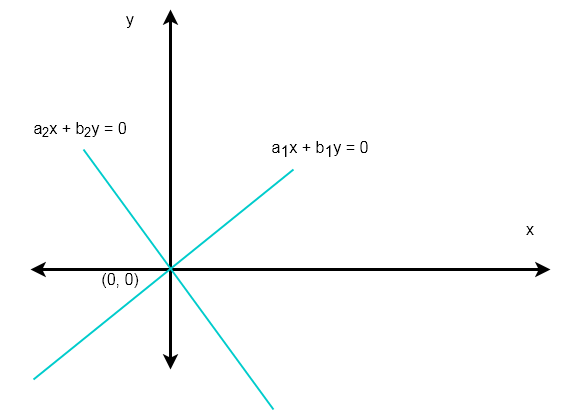
If the homogeneous system linear equations has  equations with unknowns where
  then we can say that it is guaranteed to have a non-trivial solutions.
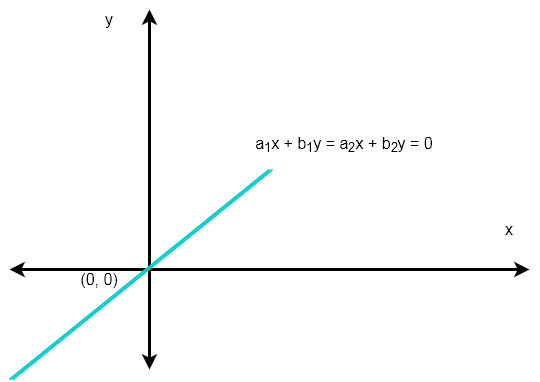
To solve a system of linear equation we perform Gauss-Jordan elimination and the augmented matrix is reduced to echelon form or reduced row echelon form. We use the same elimination technique to reduce the homogeneous system of linear equations. For example, consider following homogeneous system of linear equations.
\begin{aligned}
&x_2 + x_4 = 0\\\\
&x_1 - x_3 + x_4 = 0\\\\
&2x_3 - 2x_4 = 0
\end{aligned}
From the above homogeneous system of linear equations we obtained following augmented matrix.
\begin{aligned}
A = \begin{bmatrix}2 & -1 & 0 & 1 & 0\\1 & 0 & -1 & 1 & 0\\0 & 0 & 2 & -2 & 0\end{bmatrix}
\end{aligned}
Perform the Gauss-Jordan Elimination on the matrix
\begin{aligned}
&R3 = \frac{R3}{2}
\end{aligned}
\begin{aligned}
&A = \begin{bmatrix}2 & -1 & 0 & 1 & 0\\1 & 0 & -1 & 1 & 0\\0 & 0 & 1 & -1 & 0\end{bmatrix}
\end{aligned}\begin{aligned}
R1 \longleftrightarrow R2
\end{aligned}\begin{aligned}
&A = \begin{bmatrix}1 & 0 & -1 & 1 & 0\\2 & -1 & 0 & 1 & 0\\0 & 0 & 1 & -1 & 0\end{bmatrix}
\end{aligned}\begin{aligned}
R2 = R2 - 2R1
\end{aligned}\begin{aligned}
&A = \begin{bmatrix}1 & 0 & -1 & 1 & 0\\0 & -1 & 2 & -1 & 0\\0 & 0 & 1 & -1 & 0\end{bmatrix}
\end{aligned}The matrix is in echelon form and we obtained new homogeneous system of linear equations.
\begin{aligned}
&x_1 - x_3  + x_4 = 0\\\\
& -x_2 + 2x_3 - x_4 = 0\\\\
&x_3 - x_4 = 0
\end{aligned}
The first variable in each equation is called basic variable and other variables are free variables.
Let basic variables be  and free variables be
  for
for  .
.
\begin{aligned}
b_n = \sum f_1 + f_2 ... f_n
\end{aligned}
Using the above, the reduced form of homogeneous system of linear equation becomes
\begin{aligned}
&x_1 = x_3  - x_4\\\\
&x_2 = 2x_3 - x_4\\\\
&x_3 = x_4\\\\
&x_4 = c
\end{aligned}
Therefore, the general solution for the given homogeneous system of linear equation is
\begin{aligned}
&x_1= x_3 - c\\\\
&x_2= 2x_3 - c\\\\
&x_3 = c\\\\
&x_4 = c
\end{aligned}
We can make few conclusions based on the example above.
- The echelon form of a homogeneous system of linear equations is also a homogeneous linear equations.
- The non-trivial solution is possible, if m equations and n unknowns with m <= n and after the matrix A is reduced to echelon form with t non-zero rows obtained where t < n.
Relationship Between Non-Homogeneous System And Homogeneous System
There is a relationship between non-homogeneous system of linear equations and homogeneous systems which allows to obtain all solutions to non-homogeneous systems.
Let be a matrix of size and be a column matrix of size  such that
  is consistent with a solution
  Then every solution
  can be written as
s = s_1 + p
where p is solution to homogeneous system of linear equations  which means
  .
.
This kind of solution is obtained by linear translations about which you will learn in future articles.
Trace Of Matrix
Matrix has a special function called trace function. If is a square matrix then the sum of its main diagonal entry is called trace of matrix and is denoted by  .
.
Let be a square matrix with size  , then
\begin{aligned}
A = \begin{bmatrix}a_{11} & a_{12} & a_{13}\\a_{21} & a_{22} & a_{23}\\a_{31} & a_{32} & a_{33}\end{bmatrix}
\end{aligned}
The trace of matrix is,
\begin{aligned}
tr(A) = a_{11} + b_{22} + c_{33}
\end{aligned}
Let is see few examples of traces of matrices.
Example #1
Let A be a square matrix of size 
\begin{aligned}
A = \begin{bmatrix}-1 & 4 & 2\\6 & 2 & 7\\5 & 1 & 8\end{bmatrix}
\end{aligned}
The trace of the matrix A is,
\begin{aligned}
&tr(A) = (-1) + 2 + 8 = 9\\\\
&tr(A) = 9
\end{aligned}
Example #2
Let B be a square matrix of size  .
.
\begin{aligned}
B = \begin{bmatrix}6 & 1 & 1 & -2\\5 & 9 & -1 & 3\\0 & 1 & 7 & 2\\3 & 7 & 8 & 5\end{bmatrix}
\end{aligned}
The trace of matrix B is,
\begin{aligned}
&tr(B) = 6  + 9 + 7 + 5 = 27\\\\
&tr(B) = 27
\end{aligned}
If the matrix A is not a square matrix, then is not defined.
Matrix Transpose
The transpose of a matrix is denoted by is obtained by changing rows into columns or columns to rows of a matrix . If size of the matrix is then the size of the transposed matrix is  .
.
Transpose Of A Matrix
The element in  row and
  column of matrix becomes the row and column element in matrix .
\begin{aligned}
&(A^T)_{ij} = (A)_{ji}
\end{aligned}
Let be a matrix of size .
\begin{aligned}
A = \begin{bmatrix}a & b\\ c & d\\ e & f\end{bmatrix}
\end{aligned}
Transpose of matrix .
\begin{aligned}
A^T = \begin{bmatrix}a & c & e\\ b & d & f\end{bmatrix}
\end{aligned}
Let us take element ‘c’ which is at 2nd row and 1st column of matrix ; after transpose operation on matrix , it is at the position of 1st row and 2nd column of matrix .
Similarly, the element ‘b’ is at the position of first row and second column of matrix , but after the transpose operation, its position changes to 2nd row and 1st column in matrix .
Example #1
Transpose the following matrix A.
\begin{aligned}
A = \begin{bmatrix}3 & 1 & 5\\ 2 & 6 & 9\end{bmatrix}
\end{aligned}
The transpose of matrix is
\begin{aligned}
A^T = \begin{bmatrix}3 & 2\\ 1 & 6\\5 & 9\end{bmatrix}
\end{aligned}
Example #2
Transpose the following matrix B.
\begin{aligned}
&A = \begin{bmatrix}1 & 5\\ 7 & 6\\8 & 4\end{bmatrix}
\end{aligned}
The transpose of matrix is
\begin{aligned}
A^T = \begin{bmatrix}1 & 7 & 8\\ 5 & 6 & 4\end{bmatrix}
\end{aligned}
Symmetric Matrix
When the transpose of the matrix is the original matrix itself, then it is called a Symmetric matrix. Suppose is a matrix of size , then the transpose of matrix  .
.
All the elements above the diagonal is a mirror image of elements below the diagonal elements. That is, ![A = [a_{ij}]_{m \times n}](https://notesformsc.org/wp-content/ql-cache/quicklatex.com-ef05de009a7d7a8bcc01bd00d8157b94_l3.png "Rendered by QuickLaTeX.com") is symmetric matrix if
is symmetric matrix if 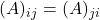 for all i and j.
\begin{aligned}
A = \begin{bmatrix}a_{11} & p & q\\p & a_{22} & r\\q & r & a_{33}\end{bmatrix}
\end{aligned}
The elements of  . The transpose of such a matrix is,
\begin{aligned}
A^T = \begin{bmatrix}a_{11} & p & q\\p & a_{22} & r\\q & r & a_{33}\end{bmatrix}
\end{aligned}
Therefore,
\begin{aligned}
A = A^T
\end{aligned}
What Are The Properties Of A Transpose Of A Matrix ?
In this section, we shall discuss about the properties of a transpose of a matrix. There are 4 interesting properties of a transpose as listed below.
 , where is a matrix of size or
  .
. , where and are of same size, that is, or .
 , where is matrix of size or and
  is a real number.
 , where and are matrices of size
  and
and  .
.
 , where
 Let us verify each of the statement.
#1 :
The transpose of a transpose of matrix is the original matrix .
\begin{aligned}
Let \hspace{5px}A = \begin{bmatrix}2 & 3\\-1 & 5\end{bmatrix}
\end{aligned}
Transpose of matrix .
\begin{aligned}
A^T = \begin{bmatrix}2 & -1\\3 & 5\end{bmatrix}
\end{aligned}
Transpose of .
\begin{aligned}
(A^T)^T = \begin{bmatrix}2 & 3\\-1 & 5\end{bmatrix}
\end{aligned}
From the results above, it is clear that  where is a matrix of size or .
#2 :
The transpose of sum of two matrices and of same size or is equal to sum of transpose of matrices and .
Let and be two matrices of same size. Then
\begin{aligned}
&A = \begin{bmatrix}1 & 5\\-2 & 3\end{bmatrix}   B = \begin{bmatrix}2 & 1\\5 & -1\end{bmatrix}\\\\
&(A + B) = \begin{bmatrix}3 & 6\\3 & 2\end{bmatrix}
\end{aligned}
Transpose of matrix  .
.
\begin{aligned}
(A + B)^T = \begin{bmatrix}3 & 3\\6 & 2\end{bmatrix}
\end{aligned}
Now, we shall take transpose of matrix and matrix and add them together to obtain  .
.
\begin{aligned}
A = \begin{bmatrix}1 & 5\\-2 & 3\end{bmatrix}   B = \begin{bmatrix}2 & 1\\5 & -1\end{bmatrix}
\end{aligned}
Transpose of A.
\begin{aligned}
A^T = \begin{bmatrix}1 & -2\\5 & 3\end{bmatrix}
\end{aligned}
Transpose of B.
\begin{aligned}
B^T = \begin{bmatrix}2 & 5\\1 & -1\end{bmatrix}
\end{aligned}
Sum of and  .
.
\begin{aligned}
A^T + B^T = \begin{bmatrix}3 & 3\\6 & 2\end{bmatrix}
\end{aligned}
#3 :
A transpose of the product of matrix with scalar  is equal to the product of scalar and transpose of matrix where size of the matrix is or and is a real number.
\begin{aligned}
&Let \hspace{5px} A = \begin{bmatrix}2 & 3\\1 & 7\end{bmatrix} \hspace{4px} and \hspace{5px} r = 2\\\\
&(rA) = \begin{bmatrix}4 & 6\\2 & 14\end{bmatrix}
\end{aligned}
Transpose of  ,
,
\begin{aligned}
(rA)^T = \begin{bmatrix}4 & 2\\6 & 14\end{bmatrix}
\end{aligned}
Similarly, let us take transpose of .
\begin{aligned}
A^T = \begin{bmatrix}2 & 1\\3 & 7\end{bmatrix}
\end{aligned}
The product  is,
is,
\begin{aligned}
rA^T = \begin{bmatrix}4 & 2\\6 & 14\end{bmatrix}
\end{aligned}
Therefore, 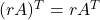 .
.
The output of both the products are equal and the property is true for all matrices.
#4 :
The transpose of product of two defined (  and
and  ) matrices and is equal to the product of transpose of matrix and transpose of matrix . Let us verify this claim with the help of an example.
\begin{aligned}
&Let \hspace{5px}A = \begin{bmatrix}1 & 5\\2 & 1\end{bmatrix} \hspace{5px} and \hspace{5px} B = \begin{bmatrix}3 & -1\\2 & 3\end{bmatrix}\\\\
&AB = \begin{bmatrix}3 + 10 & -1 + 15\\6 + 2 & -2 + 3\end{bmatrix}= \begin{bmatrix}13 & 14\\8 & 1\end{bmatrix}
\end{aligned}
Transpose of .
\begin{aligned}
(AB)^T = \begin{bmatrix}13 & 8\\14 & 1\end{bmatrix}
\end{aligned}
Similarly, the transpose of matrix and matrix is,
\begin{aligned}
&B^T = \begin{bmatrix}3 & 2\\-1 & 3\end{bmatrix} \hspace{5px} and \hspace{5px} A^T = \begin{bmatrix}1 & 2\\5 & 1\end{bmatrix}\\\\
&B^TA^T = \begin{bmatrix}3 + 10 & 6 + 2\\-1 + 15 & -2 + 3\end{bmatrix}\\\\
&B^TA^T = \begin{bmatrix}13 & 8\\14 & 1\end{bmatrix}\\\\
&Therefore, \hspace{5px}(AB)^T = B^TA^T
\end{aligned}
Once again, the product of both sides of the equation of the property  holds true. The property is valid.
In the next, post we will discuss more about symmetric and skew-symmetric matrices.
Matrix Multiplication
The multiplication of matrices means rows of matrix is multiplied to columns of to obtain a third matrix . We also evaluate the matrix multiplication with respect to fundamental properties of mathematics such as commutative, associative property, identity property.
Conditions for Matrix Multiplication
If and are two matrices with sizes and  respectively. The following conditions apply to matrix multiplication,
- Row or column of matrix must be equal to column or row of matrix .
- Multiplying matrix to matrix is not same as multiplying matrix i.e.,
 .
. - If condition 2 and 3 are true, then we can multiply 2 or more matrices.
 .
.Matrix Multiplication
Let  and
and  be two matrices with elements. Then the matrix multiplication can be done as follows.
\begin{aligned}
&A = \begin{bmatrix}a_{11} & a_{12}& . . . & a_{1n}\end{bmatrix} B = \begin{bmatrix}b_{11} \\ b_{21} \\ : \\ b_{n1}\end{bmatrix}\\\\
&C_{1 \times 1} = A . B = \begin{bmatrix}a_{11}b_{11} + a_{12}b_{21} + ... + a_{1n}b_{n1}\end{bmatrix}
\end{aligned}
In the above example, has size where  and has size where the resultant matrix has size of
  which is .
Now, we consider the second case, where we multiply to .
\begin{aligned}
&B = \begin{bmatrix}b_{11} \\ b_{21} \\ : \\ b_{n1}\end{bmatrix} A = \begin{bmatrix}a_{11} & a_{12}& . . . & a_{1n}\end{bmatrix}\\\\
&C_{n \times n} = A . B = \begin{bmatrix}b_{11}a_{11} & b_{11}a_{12} & ... & b_{11}a_{1n}\\ b_{21}a_{11} & b_{21}a_{11} & ... & b_{21}a_{1n}\\ : & : & : & :\\ b_{n1}a_{11} & b_{n1}a_{12} & ... & b_{n1}a_{1n}\end{bmatrix}
\end{aligned}
Matrix Multiplication Examples
In this section, we will show you few examples with different kinds of matrices.
Example #1
\begin{aligned}
&// \hspace{5px} Multiplying \hspace{5px} Square \hspace{5px}Matrix\\\\
&A_{2 \times 2} = \begin{bmatrix}2 & 3 \\ 1 & 7\end{bmatrix}   B_{2 \times 2} = \begin{bmatrix}2 & 3\\ 1 & 1\end{bmatrix}\\\\
&AB = \begin{bmatrix}(2 * 2)+ (3 * 1) & (2 * 3)+ (3 * 1)\\ (1 * 2) + (7 * 1) & (1 * 3) + ( 7 * 1)\end{bmatrix}\\\\
&AB = \begin{bmatrix}(4)+ (3) & (6)+ (3)\\ (2) + (7) & (3) + (7)\end{bmatrix}\\\\
&AB_{2 \times 2} = \begin{bmatrix}7 & 9\\ 9 & 10\end{bmatrix}
\end{aligned}
The size of matrix is where  and size of matrix is also
  where
where  . Therefore, resultant matrix after multiplication has a size of
  where
where  . In other words,
  .
.
Example #2
\begin{aligned}
&A_{2 \times 3} = \begin{bmatrix}4 & -1 & 1\\ 4 & 1 & -2\end{bmatrix}   B_{3 \times 2} = \begin{bmatrix}2 & -2\\ 1 & -2 \\ 5 & 2\end{bmatrix}\\\\
&AB = \begin{bmatrix}(4 * 2)+ (-1 * 1) + (1 * 5) & (4 * -2)+ (-1 * -2) + (1 * 2)\\ (4 * 2) + (1 * 1) + (-2 * 5) & (4 * -2) + ( 1 * -2) + (-2 * 2)\end{bmatrix}\\\\
&AB = \begin{bmatrix}(8)+ (-1) + (5) & (-8)+ (2) + (2)\\ (8) + (1) + (-10) & (-8) + (-2) + (-4)\end{bmatrix}\\\\
&AB = \begin{bmatrix}12 & -4\\ -1 & -14\end{bmatrix}
\end{aligned}
The size of the matrix is where  and the size of the matrix is where
  . Therefore, the resultant matrix has a size of which is .
Example #3
\begin{aligned}
&A_{3 \times 2} = \begin{bmatrix}1 & 1 \\ 3 & 5 \\ 2 & 3\end{bmatrix}   B_{2 \times 3} = \begin{bmatrix}3 & 1 & 0\\ 7 & 4 & 1 \end{bmatrix}\\\\
&AB = \begin{bmatrix}(1 * 3)+ (1 * 7) & (1 * 1) + (1 * 4) & (1 * 0) + (1 * 1)\\ (3 * 3)+ (5 * 7) & (3 * 1) + (5 * 4) & (3 * 0) + (5 * 1)\\ (2 * 3)+ (3 * 7) & (2 * 1) + (3 * 4) & (2 * 0) + (3 * 1)\\\end{bmatrix}\\\\
&AB = \begin{bmatrix}(3)+ (7) & (1) + (4) & (0) + (1)\\ (9)+ (35) & (3) + (20) & (0) + (5)\\ (6)+ (21) & (2) + (12) & (0) + (3)\\\end{bmatrix}\\\\
&AB = \begin{bmatrix}10 & 4 & 1\\ 44 & 23 & 5\\ 27 & 14 & 3\end{bmatrix}
\end{aligned}
The matrix has a size of where and matrix has a size of where  . The size of resultant matrix is which is .
Properties of Matrix Multiplication
Since, matrix operation is mathematical operations, therefore, matrix multiplication must preserve all or some of the properties with respect to multiplication operator.
Commutative Law
Suppose we multiply two matrix and ,
\begin{aligned}
&A = \begin{bmatrix}2 & 2\\ 3 & 1\end{bmatrix}   B = \begin{bmatrix}1 & 2\\ 5 & 2\end{bmatrix}\\\\
&AB = \begin{bmatrix}12 & 8\\ 8 & 8\end{bmatrix}\\\\
&Similarly, \\\\
&B = \begin{bmatrix}1 & 2\\ 5 & 2\end{bmatrix} A = \begin{bmatrix}2 & 2\\ 3 & 1\end{bmatrix}\\\\
&BA = AB = \begin{bmatrix}8 & 4\\ 16 & 12\end{bmatrix}\\\\
&AB \neq BA
\end{aligned}
From the example above, it is clear that the product of is not equal to the product of  . Hence, the commutative law does not work in the case of matrix multiplication.
Associative Law of Matrix Multiplication
The associative law in matrix multiplication involves more than two matrices in following ways.
Let A, B, and C be three matrices that meet the conditions of matrix multiplication.Then,
\begin{aligned}
A * ( B * C ) = (A * B) * C
\end{aligned}
We can test the above property with the help of an example. Let  and be 3 square matrices of size .
\begin{aligned}
&A = \begin{bmatrix}1 & 2\\3 & 4\end{bmatrix} B = \begin{bmatrix}2 & 3\\4 & 5\end{bmatrix} C = \begin{bmatrix}3 & 2\\1 & 1\end{bmatrix}\\\\
&BC = \begin{bmatrix}9 & 7\\17 & 13\end{bmatrix}\\\\
&A * (BC) = \begin{bmatrix}43 & 33\\95 & 73\end{bmatrix}\\\\
&Similarly, \\\\
&AB = \begin{bmatrix}10 & 13\\22 & 29\end{bmatrix}\\\\
&(AB) * C = \begin{bmatrix}43 & 33\\95 & 73\end{bmatrix}\\\\
&Therefore, \\\\
&A * (B * C) = (A * B) * C
\end{aligned}
The above example, both side of the equation gives same results. Thus, the associative law is true for matrix multiplication.
Identity Law
In mathematics, an identity element is a value when added element ‘a’ will give ‘a’ itself. We know that identity of addition is 0.
\begin{aligned}
&a + 0 = a\\\\
&For \hspace{5px}multiplication,\\\\
&a * 1 = 1
\end{aligned}
Since, 1 is the identity element of multiplication, we need a matrix with main diagonals as 1s, such a matrix is called an identity matrix or unit matrix denoted by  where is the size . Therefore, identity matrix is a square matrix.
Let A be a square matrix of size 2 x 2 and I be identity matrix of size 2 x 2. Then,
\begin{aligned}
&A = \begin{bmatrix}2 & 4\\4 & 6\end{bmatrix} I_{2} = \begin{bmatrix} 1 & 0\\0 & 1\end{bmatrix}\\\\
&A.I_{2} = \begin{bmatrix}2 + 0 & 0 + 4\\4 + 0 & 0 + 6\end{bmatrix}\\\\
&A.I_{2} = \begin{bmatrix}2 & 4\\4 & 6\end{bmatrix}
\end{aligned}
The unit matrix when multiplied with matrix gives the same matrix as result. Therefore, identity law is true for matrix multiplication.
Commutative Property For Identity Law
We mentioned earlier that the commutative property does not apply for matrix multiplication. However, in the case of multiplying a matrix with an identity matrix , the commutative property is true.
For example, let us take previous example where we found following results.
\begin{aligned}
A.I_{2} = \begin{bmatrix}2 & 4\\4 & 6\end{bmatrix}
\end{aligned}
We must find  to verify our claim that the commutative law does work when multiplied with an identity matrix.
Let A be a square matrix of size 2 x 2 and I be identity matrix of size 2 x 2. Then
\begin{aligned}
&I_{2} = \begin{bmatrix} 1 & 0\\0 & 1\end{bmatrix}  A = \begin{bmatrix}2 & 4\\4 & 6\end{bmatrix}\\\\
&I_{2}. A = \begin{bmatrix}2 + 0 & 4 + 0\\0 + 4 & 0 + 6\end{bmatrix}\\\\
&A.I_{2} = \begin{bmatrix}2 & 4\\4 & 6\end{bmatrix}
\end{aligned}
Clearly, commutative law is true in the case of matrix multiplication if one of the matrix is identity matrix. You can try to perform the multiplication with more than two matrices. Therefore,  .
.
In the next post, we will discuss about taking transpose of a matrix.
Matrix Subtraction
In the previous post, you have learned about matrix addition and its mathematical properties. The matrix subtraction is also mathematical operation on two matrices where elements of right hand matrix is subtract from elements of matrix on the left hand. The result is stored in a separate third matrix.
Condition To Subtract Matrices
Similar to matrix addition, there are few conditions for matrix subtraction. The minuend matrix should be on the left hand side and subtrahend matrix on the right The result of the subtraction must be stored in a difference matrix. The size of all three matrices must be same.
\begin{aligned}
&\hspace{5px}A - B = C\\\\
&=\begin{bmatrix} a_{11} & a_{12} & a_{13}\\a_{21} & a_{22} & a_{23}\\a_{31} & a_{32} & a_{33}\end{bmatrix}  - \begin{bmatrix} b_{11} & b_{12} & b_{13}\\b_{21} & b_{22} & b_{23}\\b_{31} & b_{32} & b_{33}\end{bmatrix}\\\\
& =\begin{bmatrix} a_{11}- b_{11} & a_{12}- b_{12} & a_{13}- b_{13}\\a_{21}-b_{21} & a_{22}-b_{22} & a_{23}- b_{23}\\a_{31} - b_{31}& a_{32} - b_{32} & a_{33} - b_{33}\end{bmatrix}\\\\
&C =\begin{bmatrix} c_{11} & c_{12} & c_{13}\\c_{21} & c_{22} & c_{23}\\c_{31} & c_{32} & c_{33}\end{bmatrix}
\end{aligned}
The matrix $A$ is minuend and matrix $B$ is subtrahend. The difference is stored in the matrix $C$.
Mathematical Properties of Matrix Subtraction
The properties of matrix addition such as commutative, associative , scalar multiplication, also applies to subtraction, in other words, the elements of both matrix are performing addition, but one or more elements happen to be negative number.
For example, another way to look at the matrix subtraction is as follows where $A$ and $B$ are two matrices.
\begin{aligned}
A - B = A + (-1 * B ) = C
\end{aligned}
The above equation will yield same results.
Example
In this example, we will subtract matrix $B$ from matrix $A$ and keep the difference in matrix $C$.
\begin{aligned}
&A - B = C\\\\
&=\begin{bmatrix} 5 & 4 & 3\\1 & 2 & 3\\9 & 8 & 7\end{bmatrix} - \begin{bmatrix} 2 & 1 & 0\\1 & 1 & 1\\2 & 4 & 5\end{bmatrix}\\\\
&=\begin{bmatrix} 5 - 2 & 4 - 1 & 3 - 0\\1 - 1 & 2 - 1 & 3 - 1\\9 - 2 & 8 - 4 & 7 - 5\end{bmatrix}\\\\
&C =\begin{bmatrix} 3 & 3 & 3\\0 & 1 & 2\\7 & 4 & 2\end{bmatrix}
\end{aligned}
Though the above example shows positive elements, its not always true and one must careful while subtracting from a negative numbers as the sign must change.
Matrix Addition
Previous article, you learned that matrix are two dimensional representation of data other than augmented matrix from a system of linear equations. Matrix operations such as addition is possible because you can add two matrices $latex A&s=1$ and $latex B&s=1$ by simply adding their corresponding elements which will give a thrid matrix as a result.
Condition To Add Two Matrices
You can add a matrix like ordinary numbers simply by adding each corresponding elements of two matrices. This is only possible if size of both matrices are same.
Also, the order of matrix addition is not important because addition has commutative property.
Let $A$ and $B$ be two matrices of same size.
\begin{aligned}
&A_{2 \times 3} = \begin{bmatrix} a_{11} & a_{12} & a_{13}\\a_{21} & a_{22} & a_{23}\end{bmatrix}_{2 \times 3}\\\\
&B_{2 \times 3} = \begin{bmatrix} b_{11} & b_{12} & b_{13}\\b_{21} & b_{22} & b_{23}\end{bmatrix}_{2 \times 3}
\end{aligned}
Both matrices of same size and the order of addition does not matter, then
\begin{aligned}
&C_{2 \times 3} = A_{2 \times 3} + B_{2 \times 3} = B_{2 \times 3} + A_{2 \times 3}\\\\
&C_{2 \times 3} = \begin{bmatrix} a_{11} + b_{11} & a_{12} + b_{12} & a_{13} + b_{13}\\a_{2 \times 3} + b_{21} & a_{22} + b_{22} & a_{23} + b_{23}\end{bmatrix}\\\\
&C_{2 \times 3} = \begin{bmatrix} c_{11} & c_{12} & c_{13}\\c_{21} & c_{22} & c_{23}\end{bmatrix}
\end{aligned}
Properties of Matrix Addition
The addition operation has certain fundamental properties that applies to all real numbers. Since, matrix addition is also a common addition, these fundamental mathematical properties applies to them as well.
Commutative Property
If A and B are two independent matrices of same size, then
\begin{aligned}
&A + B = B + A
\end{aligned}
Example
\begin{aligned}
&A = \begin{bmatrix} 1 & 2 & 3\\6 & 5 & 4\end{bmatrix} \hspace{3ex} B = \begin{bmatrix} 2 & 1 & 5\\1 & 1 & 0\end{bmatrix}
\end{aligned}
\begin{aligned}
C = A + B = \begin{bmatrix} 3 & 3 & 8\\7 & 6 & 4\end{bmatrix} = B + A
\end{aligned}Associative Property
If A, B and C are three matrices of same size then,
\begin{aligned}
(A + B)+ C = A + (B + C)
\end{aligned}
Example
\begin{aligned}
A = \begin{bmatrix} 1 & 2 & 3\\6 & 5 & 4\end{bmatrix} \hspace{3ex} B = \begin{bmatrix} 2 & 1 & 5\\1 & 1 & 0\end{bmatrix} \hspace{3ex} C = \begin{bmatrix} 1 & 1 & 1\\1 & 2 & 1\end{bmatrix}
\end{aligned}
\begin{aligned}
&(A + B) + C = \begin{bmatrix} 3 & 3 & 8\\7 & 6 & 4\end{bmatrix} + \begin{bmatrix} 1 & 1 & 1\\1 & 2 & 1\end{bmatrix}\\\\
&(A + B) + C = \begin{bmatrix} 4 & 4 & 9\\8 & 8 & 5\end{bmatrix}
\end{aligned}Similarly,
\begin{aligned}
&A + (B + C) = \begin{bmatrix} 1 & 2 & 3\\6 & 5 & 4\end{bmatrix} + \begin{bmatrix} 3 & 2 & 6\\2 & 3 & 1\end{bmatrix}\\\\
&A + (B + C) = \begin{bmatrix} 4 & 4 & 9\\8 & 8 & 5\end{bmatrix}
\end{aligned}
Identity Property
The identity element for addition (+) is $0$. You add $0$ to element $a + 0 = a$. The result is always $a$. Therefore, if we add matrix A to a zero matrix, the result is A matrix itself.
\begin{aligned}
A + O = A
\end{aligned}
Example
\begin{aligned}
&A = \begin{bmatrix} 1 & 2 & 3\\6 & 5 & 4\end{bmatrix} \hspace{3ex} O = \begin{bmatrix} 0 & 0 & 0\\0 & 0 & 0\end{bmatrix}\\\\
&A + O = \begin{bmatrix} 1 & 2 & 3\\6 & 5 & 4\end{bmatrix}
\end{aligned}
There are other interesting properties of matrix addition which we discuss in future posts.
Matrix Operations
In this section, you will learn common mathematical operations performed on matrices. These operations range from common arithmetic operations such as addition, subtraction, multiplication to transpose matrices.
Before we proceed to learn about matrix operations, you should learn common matrix notations and terminologies used in this section.
Common Matrix Notations
An augmented matrix is derived from the system of linear equations, but there are other areas where a matrix appear as two dimensional data set with rows and columns. In general,
“A matrix is rectangular arrays of numbers called entries of the matrix”
Example
\begin{aligned}
A = \begin{bmatrix} 1 & 2 & 3\\4 & 5 & 6\\7 & 8 & 9\end{bmatrix}
B = \begin{bmatrix} a_{11} & a_{12} & a_{13}\\a_{21} & a_{22} & a_{23}\\a_{31} & a_{32} & a_{33}\end{bmatrix}
\end{aligned}
The matrix itself is denoted by a capital letter such as or . The entries of matrices are real numbers that are denoted with lowercase letters such as  etc. The subscript to the entry element denotes the position of the element within the matrix. For example,
If A is the matrix, then
\begin{aligned}
(A)_{ij} = a_{ij}
\end{aligned}
where i is row number and j is the column number.
Size of the Matrix
The size of the matrix is denoted in terms of its rows and columns. Given a matrix, the size is where is rows and is columns. You can use any letters to represent rows and columns, however, common practice is to use and .
\begin{aligned}
C_{2 \times 3} = \begin{bmatrix} a_{11} & a_{12} & a_{13}\\a_{21} & a_{22} & a_{23}\end{bmatrix}_{2 \times 3}
\end{aligned}
The shortcut notation to represent a matrix is ![[a_{ij}]_{m \times n}](https://notesformsc.org/wp-content/ql-cache/quicklatex.com-32d08f85b1b569021ca64014a49a5701_l3.png "Rendered by QuickLaTeX.com") or
or ![[a_{ij}]](https://notesformsc.org/wp-content/ql-cache/quicklatex.com-aaaa7f5545fea25eb059ca9f9726536d_l3.png "Rendered by QuickLaTeX.com") .
.
A matrix of size  is a row matrix and is a column matrix which can be denoted using bold lowercase letters.
\begin{aligned}
&\textbf{a} = \begin{bmatrix} a_{11} & a_{12} & ... & a_{1n}\end{bmatrix}\\\\
&\textbf{c} = \begin{bmatrix} c_{11} \\ c_{12} \\ : \\ : \\ c_{m1}\end{bmatrix}
\end{aligned}
Equality Of Matrix
How do we know if two matrices are equal?
Two matrices, and are equal i.e,  if and only if
  .
.
Two matrices are equal if and only if their size are equal and all entries are equal.
Example
Let their be four matrices –  .
.
\begin{aligned}
&A  = \begin{bmatrix} 1 & 3\\ 2 & 5\end{bmatrix}_{2 \times 2}\\\\
&B  = \begin{bmatrix} 4 & 1\\ -1 & 6\\ 3 & -1\end{bmatrix}_{3 \times 2}\\\\
&C  = \begin{bmatrix} 1 & 3\\ 2 & 5\end{bmatrix}_{2 \times 2}\\\\
&D  = \begin{bmatrix} 0 & 3\\ 7 & 5\end{bmatrix}_{2 \times 2}
\end{aligned}
Lets compare matrix A with other matrices.
 because the size and elements does not match at all.
 because the size and elements does match perfectly.
 because the size match but the elements
  for some corresponding elements.
Common Matrix Operations
There are many elementary row operation about which you learned in the previous sections. However, we can perform some basic mathematical operations on elements of matrix as well. There are
- Matrix Addition
- Matrix Subtraction
- Matrix Multiplication
- Scalar Multiplication With Matrix
- Transpose Matrix
- Trace Of Matrix
The above are some common matrix operations you will find through linear algebra course. There are some advanced and complex operations about which we discuss in later part of the linear algebra tutorial.
Gaussian Elimination
Gaussian elimination is a technique to change the augmented matrix into a row echelon form.There are many echelon forms, but subsequently, we must find the reduced row echelon form. The reduced row echelon form can can be achieved through another technique called the Gauss-Jordan elimination technique.
Augmented Matrix To Row Echelon Form
Given an augmented matrix that represents a system of linear equations with n equations and m variables. We want to reduce the matrix to a simple form called the echelon form and solve the unknowns.
\begin{aligned}
&5x + y + z = 10\\
&2x + y - 3z = -5\\
&x - 2y + 2z = 3
\end{aligned}
These are the steps to achieve the row echelon form.
- Begin with column 1
- Obtain leading 1 for each row and
- Change 0 below all leading 1s.
Example
In this example we will convert the following augmented matrix into a row echelon form by series of row operations.
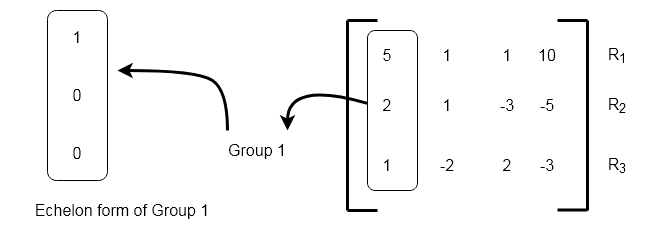
Step 1
The augmented matrix first row starts with a leading 1 and all other entries in the first column are zeros. If the first row starts with a 0 , then do row exchange with second or third row and bring a non-zero value.
To obtain leading 1 in the first row do following row operation.
\begin{aligned}
&R_{1} = \frac{R_{1}}{5}
\end{aligned}
Our resultant matrix is as follows.
\begin{aligned}
\begin{bmatrix} 1 & \frac{1}{5} & \frac{1}{5} & 2\\2 & 1 & -3 & -5\\1 & -2 & 2 & 3\end{bmatrix}
\end{aligned}
Step 2
Perform following row operations to make rest of the entries 0 in the first column under leading 1.
\begin{aligned}
&2R_{1}\\
&R_{3} =& R_{3} - R_{1}
\end{aligned}
Now, our matrix look like the following.
\begin{aligned}
\begin{bmatrix} 1 & \frac{1}{5} & \frac{1}{5} & 2\\0 & \frac{3}{5} & \frac{-17}{5} & -9\\0 & \frac{-11}{5} & \frac{9}{5} & 1\end{bmatrix}
\end{aligned}
We must repeat the same steps for Group 2.
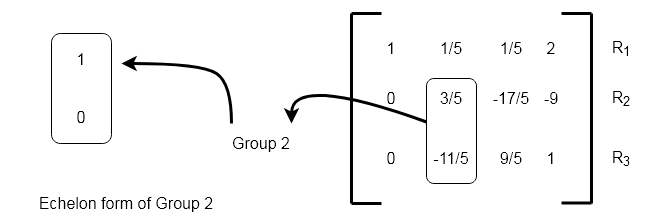
Step 3
In the group 2 which is column 2 , first change the value to leading 1.
\begin{aligned}
&R_{2} = R_{2} * 5\\
&R_{2} = \frac{R_{2}}{3}
\end{aligned}
The result of the row operation is given below.
\begin{aligned}
\begin{bmatrix} 1 & \frac{1}{5} & \frac{1}{5} & 2\\0 & 1 & \frac{-17}{3} & -15\\0 & \frac{-11}{5} & \frac{9}{5} & 1\end{bmatrix}
\end{aligned}
Step 4
All entries below leading 1 in second row must be changed to 0. Therefore, perform following row operations.
\begin{aligned}
 R_{3} = R_{3} + \frac{11}{5}R_{2}
\end{aligned}
The result is as follows. The second row leading 1 has a 0 below it in the third row.
\begin{aligned}
\begin{bmatrix} 1 & \frac{1}{5} & \frac{1}{5} & 2\\0 & 1 & \frac{-17}{3} & -15\\0 & 0 & \frac{-32}{3} & -32\end{bmatrix}
\end{aligned}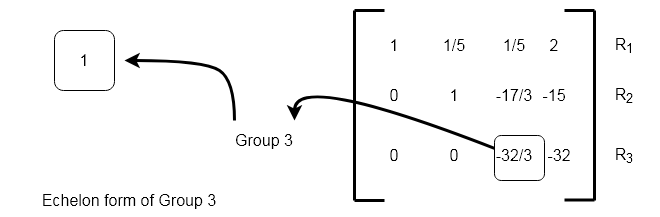
Step 5
Now, we must find the leading 1 for row 3. Do the following row operations on
\begin{aligned}
&R_{3} = \frac{R_{3}}{-32}\\
&R_{3} = R_{3} * -3
\end{aligned}
The augmented matrix is in row echelon form and it is easy to find a solution to the matrix.
\begin{aligned}
\begin{bmatrix} 1 & \frac{1}{5} & \frac{1}{5} & 2\\0 & 1 & \frac{-17}{3} & -15\\0 & 0 & 1 & 3\end{bmatrix}
\end{aligned}
Back Substitution
The echelon form gives us the following simplified system of linear equations.
\begin{aligned}
&x + \frac{y}{5} + \frac{z}{5} = 2\\
&y + \frac{-17}{3} = -15\\
&z = 3
\end{aligned}
Using value of z = 3$ and substituting in other equations,we get
\begin{aligned}
&x + \frac{2}{5} + \frac{3}{5} = 2\\\\
&x = 2 - \frac{2}{5} - \frac{3}{5}\\\\
&x = \frac{10 - 2 - 3}{5}\\\\
&x = 1\\\\

&y - 17 = -15\\\\
&y = 17-15 = 2\\\\
&z = 3
\end{aligned}
Therefore, the solution to the equation is $x = 1, y =2, z = 3$.