Table of Contents
The program to compute cosine series is based on the mathematical concept of sequences and series – particularly power series.
Problem Definition
Cosine series is a power series known as the Maclaurin expansion of \Large cos \hspace{2px} (x) where \Large x is a real number. For any given value of \Large x, the series will converges and evaluates to a finite value; the radius of convergence for the series is infinite.

We won’t be discussing, how terms of the series are generated because that would be topic for another post. The Maclaurin expansion for \Large cos \hspace{2px} (x) is for \Large x =0, however, it is true for all real values of \Large x.
In other words, it is same as finding the value of trigonometric ratio of \Large cos \hspace{2px} \theta, the cosine series will give you a better approximate value of \Large cos \hspace{2px} \theta.
Flowchart – Program for Cosine Series
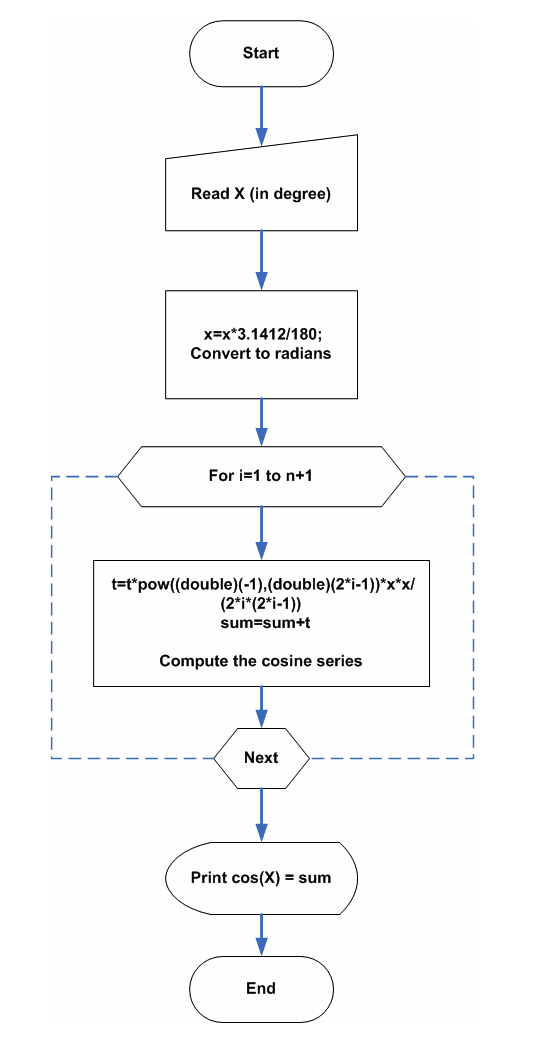
Program Codes for Cosine Series
/* Program to compute cosine series */
/* cos(x) = 1-x^2/2!+x^4/4!+x^6/6!+...+x^n/n! */
#include <stdio.h>
#include <stdlib.h>
#include <math.h>
main()
{
    float x, t, sum;
    int d;
    int i, n=20;
    /* Read the Input x value in degrees */
    printf ("Input X Value (in degrees) :");
    scanf ("%f", &x);
    d= x;
    /*converting x to radians */
    x=x*3.1412/180;
    t=1;
    sum=1;
    for (i=1; i<n+1; i++)
    {
        t=t*pow ((double) (-1), (double) (2*i-1))*x*x/ (2*i*(2*i-1));
        sum=sum+t;
    }
    /* Print the Results */
    for (i =0; i<35; i++)
    printf ("_"); printf ("\n\n");
    printf ("COS (%d) =%7.3f\n\n", (int) d, sum);
    for (i =0; i<35; i++)
    printf ("_"); printf ("\n\n");
    system ("PAUSE");
    return 0;
}
/* C++ Program to compute cosine series */
#include <iostream>
#include <cmath>
#include <cstdlib>
using namespace std;
int main() {
float x, t, sum;
int d;
int i, n = 20;
cout << "Input X Value (in degrees): ";
cin >> x;
d = static_cast<int>(x);
// Convert degrees to radians
x = x * 3.1412 / 180;
t = 1;
sum = 1;
for (i = 1; i <= n; i++) {
t = t * pow(-1.0, 2*i-1) * x * x / (2*i*(2*i-1));
sum = sum + t;
}
for (i = 0; i < 35; i++) cout << "_";
cout << "\n\n";
cout << "COS (" << d << ") = " << fixed << sum << "\n\n";
for (i = 0; i < 35; i++) cout << "_";
cout << "\n\n";
system("PAUSE");
return 0;
}/* Java Program to compute cosine series */
import java.util.Scanner;
public class CosineSeries {
public static void main(String[] args) {
Scanner sc = new Scanner(System.in);
float x, t, sum;
int d;
int n = 20;
System.out.print("Input X Value (in degrees): ");
x = sc.nextFloat();
d = (int) x;
// Convert degrees to radians
x = x * 3.1412f / 180;
t = 1;
sum = 1;
for (int i = 1; i <= n; i++) {
t = t * (float)Math.pow(-1.0, 2*i-1) * x * x / (2*i*(2*i-1));
sum = sum + t;
}
for (int i = 0; i < 35; i++) System.out.print("_");
System.out.println("\n\n");
System.out.printf("COS (%d) = %.3f\n\n", d, sum);
for (int i = 0; i < 35; i++) System.out.print("_");
System.out.println();
}
}# Python Program to compute cosine series
import math
x = float(input("Input X Value (in degrees): "))
d = int(x)
# Convert degrees to radians
x = x * 3.1412 / 180
t = 1
sum_ = 1
n = 20
for i in range(1, n+1):
t = t * (-1)**(2*i-1) * x*x / (2*i*(2*i-1))
sum_ += t
print("_"*35 + "\n")
print(f"COS ({d}) = {sum_:.3f}\n")
print("_"*35 + "\n")Output
           Input X Values(in degrees):34
           -------------------------------------
           COS(34)= 0.829
           -------------------------------------