Table of Contents
This is a simple program to find the Greatest Common Divisor (GCD) of two given positive numbers.
Problem Definition
Suppose you want to find GCD of two numbers – \Large a and \Large b. The C program for GCD has a function called \Large hcf(a, b) which is called recursively until remainder is \Large 0. The function uses the following logic on the given input numbers where a is greater than or equal to \Large b.
\Large \begin{aligned}
&r = a - (a/b * b)
\end{aligned}
Suppose \Large a = 24 and \Large b = 6 than
\large \begin{aligned}
&r = 24 - (24/6 * 6)\\
&r = 24 - 24 = 0\\
&r = 0
\end{aligned}
Then the value of \Large b is the GCD which is \Large 6. Note: – number \Large amust be greater than or equal to \Large b.
Flowchart – Program for GCD of Two Numbers
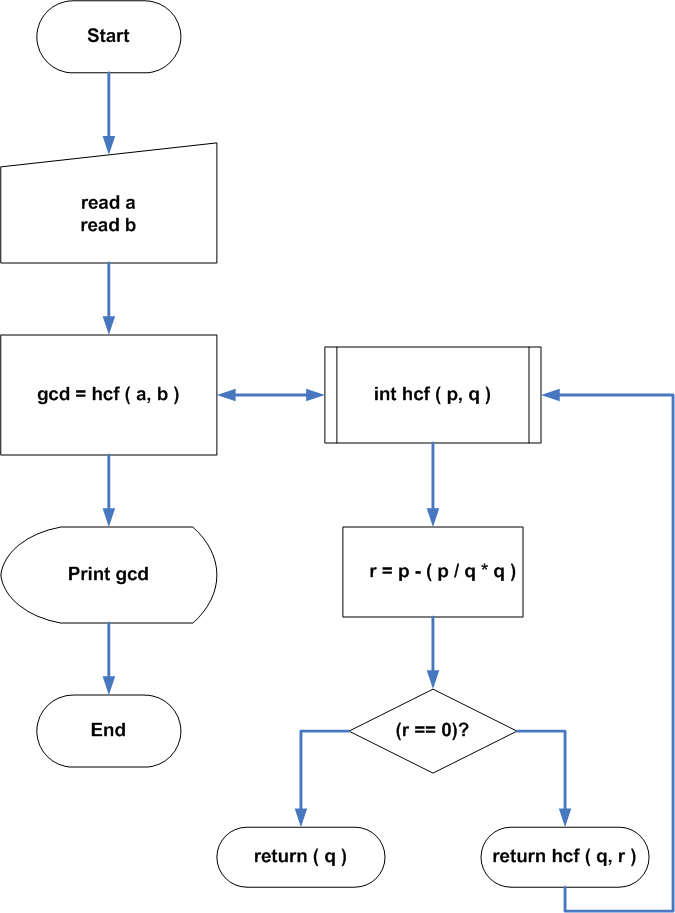
Program Codes – GCD of Two Numbers
#include <stdio.h>
#include <conio.h>
main()
{
    int i,a,b,gcd;
    int hcf();
    /* Read the input numbers */
    printf("Enter Two Numbers To Find GCD:");
    scanf("%d%d",&a,&b);
    /* Compute the GCD for given numbers */
    gcd=hcf(a,b);
    /* Print the Result */
    for(i=0;i<40;i++)
    printf("_");printf("\n\n");
    printf("GCD of %d and %d is %d\n",a,b,gcd);
    for(i=0;i<40;i++)
    printf("_");printf("\n\n");
    system("PAUSE");
    return 0;
}

int hcf(p,q)
{
    int r;
    r=p-(p/q*q);
    if(r==0)
        return(q);
    else
        return hcf(q,r);
}
#include <iostream>
using namespace std;
int hcf(int p, int q)
{
int r = p % q;
if (r == 0)
return q;
else
return hcf(q, r);
}
int main()
{
int a, b, gcd;
cout << "Enter Two Numbers To Find GCD: ";
cin >> a >> b;
gcd = hcf(a, b);
cout << "\n----------------------------------------\n";
cout << "GCD of " << a << " and " << b << " is " << gcd << endl;
cout << "----------------------------------------\n";
return 0;
}import java.util.Scanner;
class GCD
{
static int hcf(int p, int q)
{
int r = p % q;
if (r == 0)
return q;
else
return hcf(q, r);
}
public static void main(String[] args)
{
int a, b, gcd;
Scanner sc = new Scanner(System.in);
System.out.print("Enter Two Numbers To Find GCD: ");
a = sc.nextInt();
b = sc.nextInt();
gcd = hcf(a, b);
System.out.println("\n----------------------------------------");
System.out.println("GCD of " + a + " and " + b + " is " + gcd);
System.out.println("----------------------------------------");
sc.close();
}
}def hcf(p, q):
r = p % q
if r == 0:
return q
else:
return hcf(q, r)
a = int(input("Enter first number: "))
b = int(input("Enter second number: "))
gcd = hcf(a, b)
print("\n----------------------------------------")
print(f"GCD of {a} and {b} is {gcd}")
print("----------------------------------------")The important piece of code in the above source code is the call to \Large hcf(a, b) function and the function \Large hcf(a, b) calling itself recursively.
gcd = hcf(a, b);The function \Large hcf(a, b)evaluate the current value of \Large a and \Large b, and if the remainder is not equal to \Large 0, it call itself one more time until the remainder becomes \Large 0.
int hcf(p,q)
{
    int r;
    r=p-(p/q*q);
    if(r==0)
        return(q);
    else
        return hcf(q,r);
}
Output
The output of the program is given below. When the user enters \Large 24 and \Large 6, the result is \Large 6 which greatest common divisor (GCD) of \Large 24 and \Large 6
         Enter Two Numbers To Find GCD:24 6
          ------------------------------------------
          GCD of 24 and 6 is 6
          ------------------------------------------