Rewriting Expressions using Math Laws
Previously, you learned about converting words to equations and expressions. You now know the difference between expression and equation.
In this lesson, you will learn about rewriting expressions, using mathematical fundamental laws.
If two expressions are written differently, are they equal ?
That is the kind of question we are trying to answer here. I assume that you know basic addition, and multiplication.
Mathematical Laws
To ensure that expression written in different forms are equal, we will test them against mathematical laws. These laws applies to expressions involving addition and multiplication. These are:
- Commutative law
- Associative law
- Distributive law
Commutative Law
Let me discuss the Commutative laws. Let a, b and c be three whole numbers, and  is the expression.
The commutative laws states that the order of addition does not affect the result. It means that is equivalent to  .
.
You add two number in any order, the result is going to be same. This is resulting from commutative law.
Example
Our first example is a simple equation  which is same as
  . Both results in
  .
.
4 + 3 = 3 + 4 = 7
Commutative law for Multiplication
If we multiply two number in any order , the result will be same which means  is equivalent to
  . So, commutative laws applies to multiplication as well.
Let’s consider another example,
Suppose 5 and 3 are two whole numbers, if we multiply 5 with 3, the answer is 15. Let us rearrange the expression into 3 multiplied by 5 which is also 15. therefore, commutative law is true for multiplication as well.
5 \times 3 = 3 \times 5 = 15
Associative Laws
The associative laws works on addition and multiplication. If three or more numbers are added or multiplied, different groupings of numbers does not affect the results.
If a, b and c are three numbers. Then  is same as
  .
.
Example:
let  , and
, and  , then
\begin{aligned}
&(a + b ) + c = (3 + 5) + 7 \\\\
& Evaluate \hspace{3px} first \hspace{3px}  3 + 5 = 8\\\\
&8 + 7 = 15
\end{aligned}
Now we must evaluate 
\begin{aligned}
&a + (b + c) = 3 + (5 + 7) \\\\
&Evaluate \hspace{3px} first \hspace{3px}5 + 7 = 12\\\\
&3 + 12 = 15
\end{aligned}
Our expression becomes  which is equal to
  . so, by associative law addition of three numbers with different grouping is equal and does not affect the results.
Associative Law for Multiplication
The different grouping does not affect multiplication as well. You can multiply variable by grouping them in any order and it still gives same results.
Let a, b and c be three numbers multiplied together. (a multiplied by b) multiplied by c is equal to d. similarly, a multiplied by (b multiplied by c) is also equal to d, where d is a whole number.
(a \times b ) \times c = (b \times a ) \times c = d
Let us see an example of associativity of multiplication.
Example:
(2 \times 6) \times 5 = 2 \times (6 \times 5)
In the left hand expression, we must evaluate  first which is
  and then multiply with
  which gives us
  .
.
\begin{aligned}
&(2 \times 6) \times 5\\\\
&=12 \times 5 \\\\
&=60
\end{aligned}
Similarly, in the right hand side expression, we must evaluate  first which is
  and then multiplied by
  will give us .
\begin{aligned}
&2 \times (6\times 5)\\\\
&=2 \times 30 \\\\
&=60
\end{aligned}
Therefore, the equation is true and associative law is true. You can rewrite any expression using the commutative and associative laws.
Identity Law
Next I will talk about another law called the identity law. This mathematical law applies to addition and multiplication only. The identity law requires identity element in the expression. The identity element for addition is 0 and the identity element for multiplication is 1.
If a is whole number, then according to identity law,  where 0 is the identity element gives the same number a as result.
By commutative law,  is also equal to a.
a + 0 = 0 + a = a
I illustrated this with an example below.
Example:
Let us see an example, suppose  is a whole number , then
  . Also,
  .
.
Identity Law for Multiplication
For multiplication, let a be any whole number multiplied by its identity element 1, then
a \times 1 = a
we get number a itself. By commutative law,  is also, the number a..
Summary
Let me summarize what you learned.
- Commutative law says, if a and b are two whole numbers then
\begin{aligned}
&a + b = b + a\\\\
&a \times b = b \times a
\end{aligned}- The associative law says , if a, b, and c are 3 numbers,then
\begin{aligned}
&(a + b) + c = a + (b + c)\\\\
&( a \times b ) \times c = a \times ( b \times c )
\end{aligned}- The identity element involve the identity element. The identity element for addition is 0 and 1 is identity element for multiplication. Then,
\begin{aligned}
&a + 0 = 0 + a = a\\\\
&a \times 1 = 1 \times a = a
\end{aligned}
Note: examples in this article uses only two or three variables, however, if you try any of these examples with more than three variables, the result would be true only. The commutative, associative and identity laws applied to expressions with more variables.But, for simplicity I have chosen fewer than two or three variables.
Words to Equations
In the previous article, you learned about building blocks of expression, then translated phrases to expressions.
Before we begin try to answer these questions. I will tell you the answers at the end of this video.
First Question is:
Identify the equality operators in the following.
a. + b. x c. = d. /
How many of the following is an algebraic expression?
a. 3 – 2
b. 5d – r
c. 6 + 4
d. 7d
Question three is: What is an equation?
You can watch the previous video to answer some of these questions.
In this video, you are going to learn about:
what are equations?
English words that indicate equations.
Translating phrases to equations.
You know that an expression is combination of variables, constants and operators.
For example.
The sum of x and 5 can be translated to x + 5.
But,note that it is not a complete sentence.
What if we say “The sum of x and 5 is 15.”
This is a complete sentence and shows that x + 5 is equal to some other expression which is 15.
When two or more expressions give same result, we put an equal sign between them, it is called an equation.
for example.
x + 5 = 3x + 1
If x = 2,
then both side of the equation will evaluate to 7.
which means 7 = 7. That’s why its an equation.
There are so many English words that mean equality between two expressions. These words are:
is equal to
is same as
is
gives
was
will be
You can use these words to link expressions and make sentence equations.
For example.
23 plus 17 is 40.
6 is same as 5 + 1.
The product of 3 and 4 will be 12.
Sometimes you get sentence equations and asked to translate them into algebraic equations.
For example.
Translate the following
The quotient of 24 and 6 is 4.
The product of 5 and 6 is same as 12 + x.
The first equation is division of 24 by 6 which is an expression and equal to a number 4 which is a numeric expression. You can write it as 24 / 6 = 4.
The second word equation has expression 5 multiplied to 6 which is 30 equal to another expression 12 + x.
You can write it as: (5)(6) = 12 + x.
If you don’t want to write (5)(6) , then you can replace it with number 30 which is the product of 5 and 6.
Let us answer the questions that we asked in the beginning of the video.
Identify the equality operators in the following.
a. + b. x c. = d. /
The equal to operator is the right answer. When you want to compare two equal quantities, use equal to operator, this form the basis for equations.
Qestion 2 is: How many of the following is an algebraic expression?
a. 3 – 2
b. 5d – r
c. 6 + 4
d. 7d
There are two algebraic expressions in the given choices. An algebraic expression has variables , represented by some english letters, so 5d – r and 7d are algebraic expressions.
Question three is: What is an equation?
After completing the lesson, you must know that when two expressions are equal then they are separated by the equal sign called an equation. when we evaluate the equation, we must get same value on both side of the equality operator.
Words to Expressions
Before we start with this lesson. Here are some questions to test yourself about this new topic.
Q1. Identify the variables and constants in following expression.
\begin{aligned}
&2x + 5\\
&5y - 3x + 6
\end{aligned}
Q2. What is quotient of 25 and 5?
Q3. Identify whether following is an expression or an equation.
\begin{aligned}
&24 + 5\\
&45x = 4 + 2x\\
&5x - 3y
\end{aligned}
Try to answer them on your own, and I will tell you the answers at the end of the article.
Understanding Expressions
In this article, you will know how to translate word problems to expressions. But before that you must know what an expression is. To explain the expression, you must know the building blocks of an expression. The different parts are given below.
You will learn about
- Variables,
- Constants,
- Operators,
- Expressions
- Translate word problems into expressions.
Let’s start with a small example.
Variables and Constants
Every year the price of orange changes and the price of apples becomes Rs 10 more than the price of Oranges.
If orange price for a year is Rs 24 per orange, then apple price is Rs 34 per apple which is Rs 10 more than oranges.
Next year the price becomes Rs 43 , then apple price increase to Rs 53.
In algebra, we call orange price as variable, and the Rs 10 that we add to get the price of apples is called a constant.
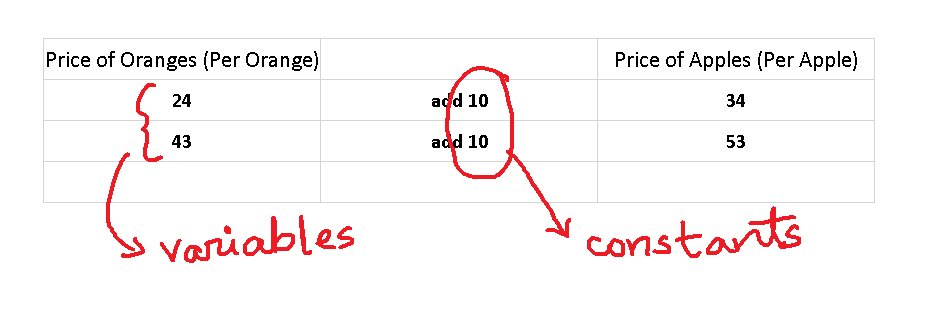
Let say price of orange is x then the price of apple would be x + 10.
\begin{aligned}
&Orange \hspace{4px}Price = x\\\\
&Apple \hspace{4px} Price = x + 10
\end{aligned}
A variable value does not remain the same, because it is changing frequently, but a contant value remain same, like the number 10.
Expression is made of variables, or constant or combination of variables, constants, and operators.
Operators
Operators are like instruction in algebra, to do something with the variables and constants. You can say that they connect variables and contants to do something called the math operations. After which you get a result.
We can do basic arithmetic operations like:
- Add
- Subtract
- Multiply
- Divide
For add use plus symbol, minus for subtraction, multiply is ‘cross’ symbol, that is sometimes confused with letter ‘x’ so we use a ‘dot’ symbol for multiplication now. Sometimes, two numbers separated by parantheses is also taken as multiplication.
Divide is a special symbol and some times we can use fraction to represent a division.
For Example,
a plus b is ‘a’ and plus symbol and ‘b’.
similarly,
‘c’ multiplied by ’12’ is ‘c’ and ‘multiplication symbol’ and ‘ number 12’.
35 divided by 5 is ‘number 35’ and divide symbol and ‘number 5’. You can create several examples like this.
There are operators for compare two quantities in algebra.
It is called the inequality operators which are:
- equal to
- not equal to
- less than
- greater than
- less than or equal to
- greater than or equal to
The inequality operators are used to compare two expressions or numbers to find out how much one number or expression is different from the other.They might be equal or not equal, or may be one is greater or less than the other.
You can use the appropriate operators in your expressions.
For example,
a is equal to b is ‘b’ and “equal to’ symbol and ‘b’.
These are the building blocks of an algebraic expressions.
Types of Expressions
The expressions are of two types.
- Numeric expressions
- Algebraic expressions.
Numeric Expressions
When you don’t use any variables, then expression is made of just numbers, it is called numeric expressions.
for example,
number 2,
3 – 5,
6 + 5 (4),are numeric expressions.
Algebraic Expressions
Similarly, when an expression has variables, as well as constants, it is called algebraic expressions.
For example,
y
x + b
3x – 4
are algebraic expressions.
The main difference between these two expressions are that numeric expression can be evaluated down to a single value.
algebraic expression cannot be evaluated to a single value unless we know the value of the variables in the expression.
Word Expressions
Sometimes expressions are given in the form of phrases, and you must find the arithmetic operation and the numbers from the phrases given.
Words that indicate addition is:
- the sum of 4 and 7
- 4 plus 7
- 7 more than 4
- 4 increased by 7
- the total of 4 and 7
- 7 added to 4
All of these phrases indicate adding a number to another number, and you can translate it into addition expression:
For example, 4 + 7
Similarly, phrases that indicate subtraction are:
- 3 minus 1
- the difference of 3 and 1
- 1 subtracted from 3
- 3 decreased by 1
- 1 less than 3
all of these phrases are equal to the expression 3 minus 1.
Similarly,
- 5 times 3
- the product of 5 and 3
indicate multiplication and can be written as:
5 * 3, 5(3), or (5)(3)
The phrases that indicate division are:
- 10 divided by 5
- the quotient of 10 and 5
- the ratio of 10 and 5
- 5 divided into 10
Converting Phrases to Expressions
So, you write these phrases into expression as
10 divide symbol and 5, other forms of expression are 10 forward slash 5, and the ration form 10 by 5.
Let translate some phrases to expression.
- six added to seven
- the quotient of 100 and x.
The first expression asks to add six to number 7, so the expression is:
7 + 6
The second phrases ask to divide 100 by x. This is an algebraic expression. It is
100 by x
Similarly, you can translate any expression into phrases that indicate an arithmetic operation.
To explore more on this topic, you read and practice from algebra books.
Solution to Quiz
The answers to the question I asked at the beginning of this video are:
Q1: Identify the variables and constants from expressions
- 2x + 5 and
- 5y – 3x + 6
Here the variables are letter, and all numbers are constants. So, in the first expression variable is x and constants are 2 and 5.
In the second expression, x and y are variables, constants are 5, 3, and 6.
Q2. What is the quotient of 25 and 5.
Given phrase, asking quotient meaning it is division of 25 by 5. So the answer is 25 divided by 5.
Question 3 ask to identify expressions and equations.
the first one is
24 + 5 which is a numeric expression.
The second one is
45x = 4 + 2x, which is equation because two expressions are compared using an equal sign.
The third one is:
5x – 3y, which is an algebraic expression.
Summary
In this lesson, you have learned the building blocks of expression and know how to convert a word expression to algebraic expression. Also, algebraic to word expressions.
Fundamentals of Algebraic Expressions
What is algebraic expression? What are the fundamental building blocks of algebraic expression? How do expressions help us solve problems? How to manipulate algebraic expressions? These are some questions that we tried to answer in Unit 1 of this algebra course. In this video, I will introduce you to the lesson that we cover in this unit.
Contents of Unit 1
In this unit, you will study about:
- tranlate word problems into algebraic expressions.
- translate word problems into equations.
- Rewrite expressions using fundamental math laws.
There will be a gentle introduction to these fundamental laws to help you understand the rest of the lessons. The next lesson is:
- Factor using distributive law.
- Prime factorization of expressions.
The lesson four and five, give the basic idea of factorization process and it is most important skill in algebra.
- Fractions and fraction arithmetics.
Here you can visualize the idea of fraction, with other important skill you will learn in this lesson. The next is:
- Real numbers and subsets of real numbers.
- Identify and solve absolute values.
- Arithmetic with or without number line.
- Word problems for negative and positive numbers.
The real numbers are the foundation of number system we have, and you will appreciate the use of negative and positive numbers in lesson 7 to 10.
Next lessons are:
- Combine like terms in an expression.
- Additive inverse in Subtraction.
- Word problems for subtraction.
- Multiply and Divide Real numbers.
The lesson 11 to 14 is all about performing fundamental math operations on real numbers. The next lessons are:
- Using exponential notations in expressions.
- Order of operations on expression.
and last lesson in this unit is: - Simplifying expression using distributive law.
The last three lesson which is, from lesson 15 to 17 is where you develop the skill of simplifying and evaluating expression.
To explore more, I suggest you reading few algebra textbooks.