Table of Contents
In this article, you will learn about distance formula , midpoint , and equations of circle. The circle is a geometric shape that has a special significance in mathematics. To study the circle, in algebraic form, we need to define it in terms of coordinates in a 2d coordinate system also known as Cartesian coordinate system.
Coordinate System
You are familiar with the 2d coordinate system already from previous articles. The 2d coordinate system define an point in terms of an ordered pair  from origin
  . The
. The  represents horizontal distance from 0 and
  represents vertical distance from
  .
.
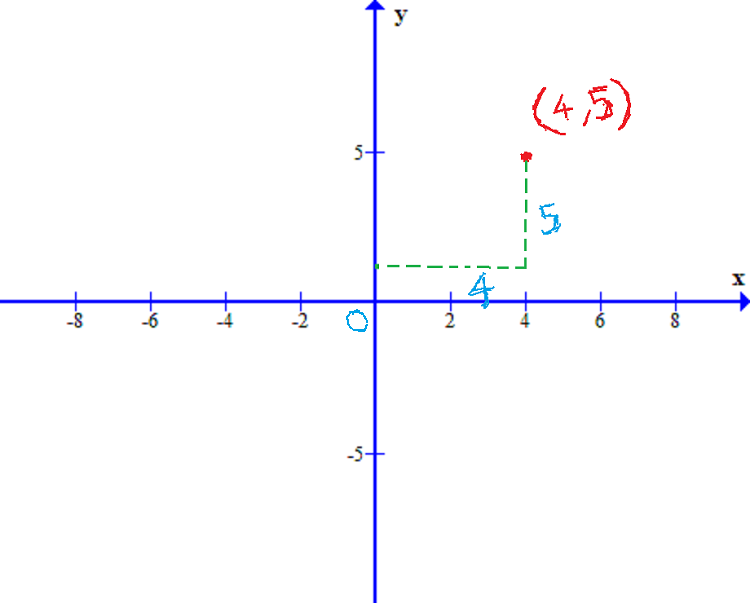
In the figure 1 above, the point  is
is  units in horizontal direction from and
  units in vertical direction from . Therefore, we must study the circle as a set of points in this 2d coordinate system.
Distance Formula
The distance formula is derived from Pythagorean theorem to find the distance between two points in the coordinate system. Suppose that  and
and  are two points in the
  plane.
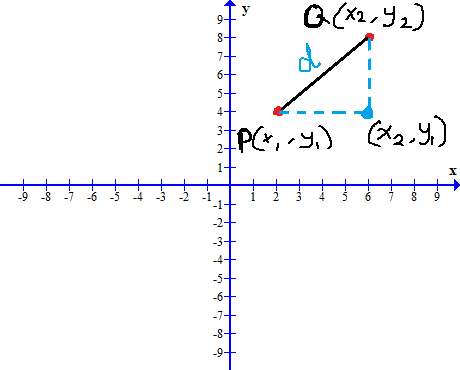
The distance between point to point involve change of value from  to
to  value and change in value from
  to
to  . This forms a right triangle in the plane.
The distance  is hypotenuse of this right triangle and
  and
and  are the lengths of sides of this right triangle. Therefore, by Pythagorean theorem,
\begin{aligned}
&d^2 = (x_1 - x_2)^2 + (y_1 - y_2)^2\\ \\
&Take \hspace{2mm} square \hspace{2mm} root \hspace{2mm} of \hspace{2mm} both\hspace{2mm}  sides. \\ \\
&\sqrt{d^2}= \sqrt{(x_1 - x_2)^2 + (y_1 - y_2)^2} \\ \\
&d =\sqrt{(x_1 - x_2)^2 + (y_1 - y_2)^2}
\end{aligned}
The distance formula is  .
.
Note that the length or  does not matter as long as we take
  or
or  . Similarly, we must take positive value, which is
  or
or  .
.
Example #1
Find the distance between point  and
and  .
.
Solution:
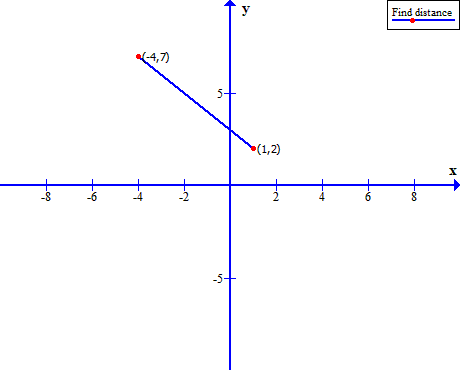
Solution:
\begin{aligned}
&Let \hspace{1mm} x_1 = -4 \hspace{1mm} and \hspace{1mm} y_1 = 7,\hspace{1mm}\\
&also \hspace{1mm}x_2 = 1 \hspace{1mm}and\hspace{1mm} y_2 = 2. \hspace{1mm}Then, \\
&(-4) - 1| = |-5| = 5 \hspace{1mm} and \hspace{1mm} |7-2| = |5| = 5
\end{aligned}
The distance between and is:
\begin{aligned}
&d = \sqrt{5^2 + 5^2}\\ \\
&d = \sqrt{50}\\ \\
&d = \sqrt{25 \cdot 2}\\ \\
&d = \sqrt{25} \cdot \sqrt{2}  \hspace{1cm} By Rule \sqrt{ab} = \sqrt{a} \cdot \sqrt{b}, {a,b} > 0\\ \\
&d = 5\sqrt{2}
\end{aligned}
Mid-Point Formula
Given any two point on the plane, you can find the mid-point  . If and
  are two points on the plane.
Then the mid-point formula is given as
\begin{aligned}
M(x, y) = \left( \frac{x_1 + x_2}{2},\frac{y_1 + y_2}{2}\right )
\end{aligned}
Example #2
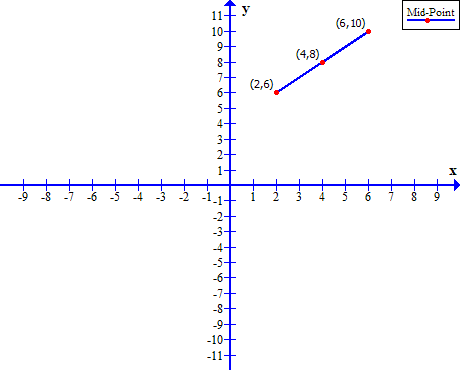
Find the mid-point of points  and
and  .
.
Solution:
We can easily find the mid-point using the mid-point formula, which is 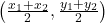 . Given points – and
  .
.
\begin{aligned}
&Let \hspace{2mm} x_1 = 2, \hspace{2mm}  and \hspace{2mm}  x_2 = 6\\ \\
&Similarly, \\ \\
&y_1 = 6,\hspace{2mm}  and \hspace{2mm} y_2 = 10\\ \\
&Using \hspace{2mm} mid-point \hspace{2mm} formula, \hspace{2mm}  get \\ \\
&M(x, y) = \frac{2 + 6}{2}, \frac{6 + 10}{2}\\ \\
&=\frac{8}{2},\frac{16}{2}\\ \\
&=(4,8)
\end{aligned}
Therefore, the mid-point  .
.
Standard Equation of Circle
A circle on the plane is set of all points that equidistant from a fixed point called the center of the circle. The equal distance between center and any point on the circle is called a radius.
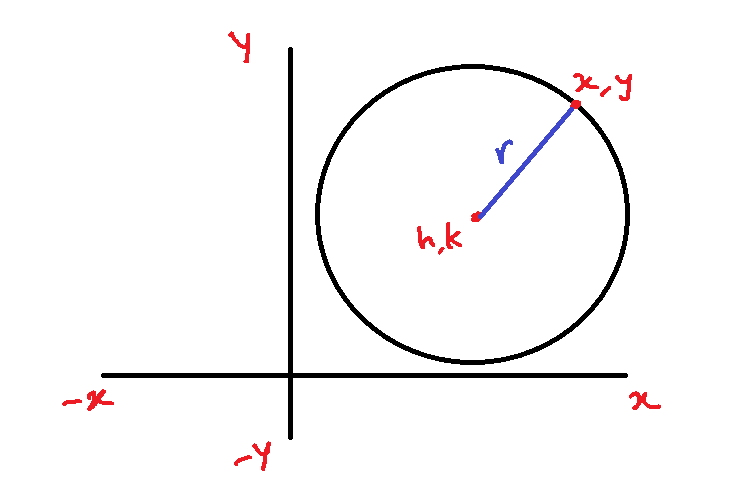
Consider the circle in figure 5, with radius  and center at
  . The point lies on the circle. Therefore, by distance formula, we know that,
\begin{aligned}
&r = \sqrt{(x-h)^2 + (y - k)^2}\\
\end{aligned}
This is the standard equation of a circle with center at .
Circle With Center At The Origin
In the co-ordinate system, the origin is point . A circle whose center is at  has the following equation.
\begin{aligned}
&r = \sqrt{(x - 0)^2 + (y - 0)^2}\\ \\
&r = \sqrt{x^2 + y^2}\\ \\
&or\\ \\
&r^2 = x^2 + y^2
\end{aligned}
Example #3
Find the radius of a circle whose center is at and the point  lies on the circle.
Solution:
Given center  and a point
  , we can use the standard equation of the circle to find the length of radius .
\begin{aligned}
&r = \sqrt{(x-h)^2 + (y - k)^2}\\ \\
&r = \sqrt{(7-1)^2 + (10-2)^2} \\ \\
&r = \sqrt{6^2 + 8^2}\\ \\
&r = \sqrt{36 + 64}\\ \\
&r = \sqrt{100} \\ \\
&r = 10 \hspace{2mm}
\end{aligned}
Therefore, the length of radius is  for circle whose center is at and is a point on the circle.
Example #4
Find the center of the circle whose radius and the point  . Also,
  .
.
Solution:
We are given the value of radius  and the point
  on the circle. To find the center point of the circle, we must use the distance formula which is
  and the value of
\begin{aligned}
&r = \sqrt{(x-h)^2 + (y-k)^2}\\ \\
&5= \sqrt{(6 - h)^2 + (8-k)^2}\\ \\
&But, \hspace{2mm} k = h + 1 \\ \\
&5= \sqrt{(6 - h)^2 + (8-(h+1))^2}\\ \\
&5 = \sqrt{(6 - h)^2+ (7 - h)^2)}\\ \\
&5 = \sqrt{36 - 12h + h^2 + 49 - 14h + h^2}\\ \\
&5 = \sqrt{85 - 26h + 2h^2 }\\ \\
&Square \hspace{2mm} both\hspace{2mm}  sides \\ \\
&25 = 85 - 26h + 2h^2 \\ \\
&2h^2 - 26h + 85 - 25 = 0\\ \\
&2h^2 - 26h + 60 = 0\\ \\
&h^2 - 13h + 30 = 0 \\ \\
&(h - 3) (h - 10) = 0\\ \\
&By \hspace{2mm} zero\hspace{2mm}  product \hspace{2mm} property\\ \\
&\therefore x = 3 \hspace{2mm} or \hspace{2mm}  x = 10
\end{aligned}
We try to use the value of in the equation. It seems that  seems more appropriate. Let us verify.
\begin{aligned}
&5 = \sqrt{(6-3)^2+(8-4)^2}\\ \\
&5 = \sqrt{3^2 +4^2 }  \hspace{1cm}  \because k = h + 1 = 3 + 1 = 4\\ \\
&5 = \sqrt{9 + 16}\\ \\
&5 = \sqrt{25 }\\ \\
&\therefore 5 = 5
\end{aligned}
General Equation Of Circle
Suppose a circle has center at  with a point on the circle . Therefore, we can find the standard equation of the circle using,
\begin{aligned}
&r^2 = (x - h)^2 + (y - k)^2\\ \\
&r^2 = (x - 3)^2 + (y - 7)^2\\ \\
&r^2 = x^2 - 6x + 9 + y^2 - 14y + 49\\ \\
&r^2 = x^2 + y^2 - 6x - 14y + 58
\end{aligned}
Therefore, the general equation of circle is  where
where  are real constants.
Example #5
Given the general equation of circle  find the coordinates for center of the circle.
Solution:
Given general equation of circle. We will solve it step-by-step. First group the similar variables together and move constant to the right side of the equation.
\begin{aligned}x^2 - 6x + y^2 -14y = - 58\end{aligned}Now solve for and by completing the square. Note that you have to add same value on both side of the equation.
[\begin{aligned}(x^2 - 6x + 9 ) + (y^2 - 14y + 49) = - 58 + 9 + 49\end{aligned}The equation is in standard form and we can find the value of easily.
[\begin{aligned}(x - 3)^2 + (y - 7)^2 = 0^2\end{aligned}The center of the circle is at  .
.