Solving System Of Linear Equations Using Cramer’s Rule
Cramer’s rule is a method of solving the system of linear equations using determinants. It is named after Gabriel Cramer (1704–1752) who discovered this method. In this article we are going to discuss and work few examples for solving system of linear equations using Cramer’s rule.
Before you start reading about Cramer’s rule, learn to compute determinant of 2 x 2 and 3 x 3 matrix as a prerequisite to this article : Finding Determinants Using Cross Multiplication.
Coefficient Matrix and Augmented Matrix
Given a system of equation you can derive a coefficient matrix and an augmented matrix from it. Both are the same thing with little different.
Suppose you are given a system of linear equations with 2 unknowns.
\begin{aligned}
&a_{11}x + a_{12}y = b_1\\\\
&a_{21}x + a_{22}y = b_2
\end{aligned}
The augmented matrix and coefficient matrix would look like the following.
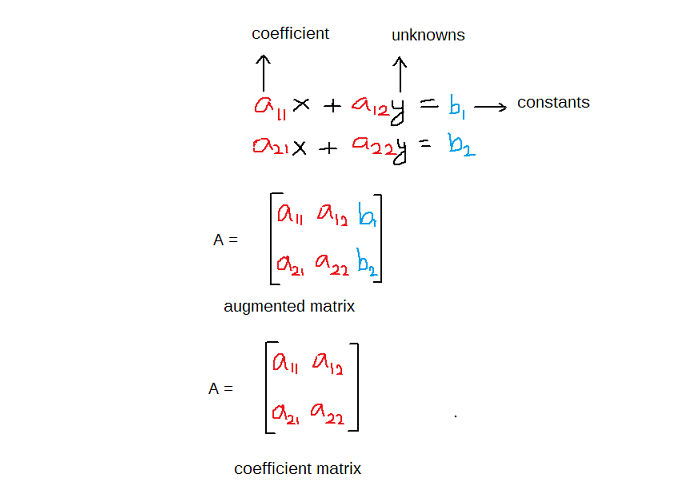
The system of linear equation is in the form of  which is written as
\begin{aligned}
&Ax = b\\\\
&\begin{bmatrix}a_{11} & a_{12}\\a_{21} & a_{22}\end{bmatrix} . \begin{bmatrix}x \\ y\end{bmatrix} = \begin{bmatrix}b_1 \\ b_2\end{bmatrix}
\end{aligned}
The matrix  is coefficient matrix,
  is a column vector of unknowns, and
  represents the constant vector.
Determinant Of 2 x 2 Matrix
The determinant of a 2 x 2 matrix can be calculated using cross multiplication.
\begin{aligned}
&A = \begin{bmatrix}a_{11} & a_{12}\\a_{21} & a_{22}\end{bmatrix}\\\\
&|A| = \begin{vmatrix}a_{11} & a_{12}\\a_{21} & a_{22}\end{vmatrix} = a_{11}a_{22} - a{12}.a_{21}
\end{aligned}
Example #1
Find the determinant of 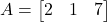 .
.
Solution:
|A|= \begin{vmatrix}2 & 1\\3 & 7\end{vmatrix} = 14 - 3 = 11Solving System of Equations with 2 Unknowns With Cramer’s Rule
Given a system of equations with 2 unknowns you can solve it using Cramer’s rule by following steps.
- Find the augmented matrix and the coefficient matrix for the system of equations.
- Find the determinant of
 of matrix
  .
. - Replace the
 coefficients of coefficient matrix with constant vector
  to get x-matrix and find its determinant
- Replace the
 coefficients of coefficient matrix with constant vector to get y-matrix and find its determinant
- Find the solution to system of linear equation according to following equations.
\begin{aligned}
&x = D_x/D\\\\
&y = D_y/D
\end{aligned}
See the following figure to understand how the matrices look like.
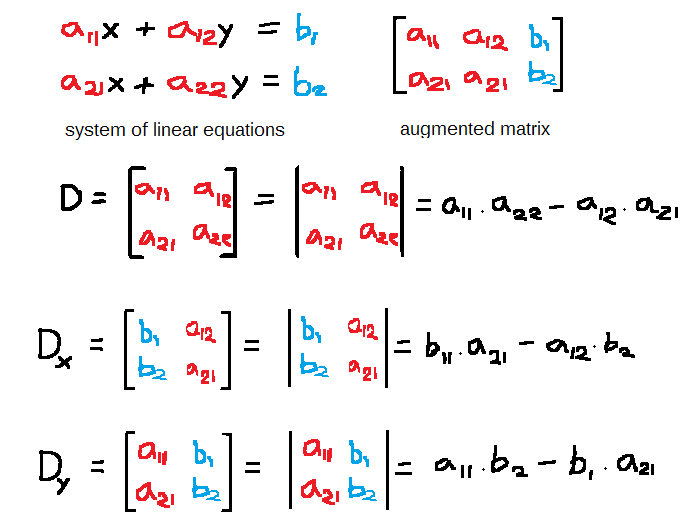
Given a system of equations such as shown above, first derive the augmented matrix and coefficient matrix. The coefficient matrix has no constant vector. Use the coefficient matrix to get the determinant of matrix which is  .
.
X Matrix And Y Matrix
You can get x matrix by replacing the first column which is x column by the constant vector. See the image below.
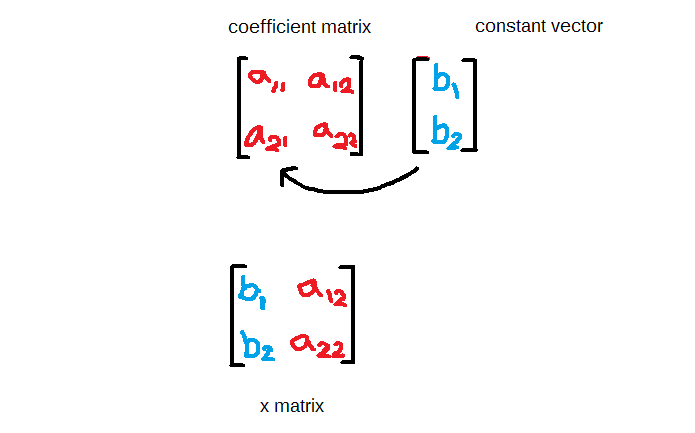
Similarly, compute the y matrix from coefficient matrix of . Compute the determinant of x matrix which is  and compute the determinant of y matrix which is
  .
.
To find the solution to each unknowns use the following formula, mentioned earlier.
Solution for x
\begin{aligned}
&x = D_x/D
\end{aligned}
Solution for y,
y = D_y/D
In the next section, we will solve a system of linear equation with two unknown.
Example #1
Find the solution to following system of linear equations with two unknowns using Cramer’s rule.
\begin{aligned}
&x + 3y = 5\\\\
&5x - 2y = 8
\end{aligned}
Solution:
Given the system of linear equations we can obtain augmented matrix and coefficient matrix.
A = \begin{bmatrix}1 & 3 & 5\\5 & -2 & 8\end{bmatrix}The coefficient matrix must be a square matrix, so lets write the augmented matrix in the form in that order.
\begin{aligned}
&Ax = b\\\\
&\begin{bmatrix}1& 3\\5 & -2\end{bmatrix} . \begin{bmatrix}x & y\end{bmatrix} = \begin{bmatrix}5 & 8\end{bmatrix}
\end{aligned}
Compute the determinant of the matrix .
D = \begin{vmatrix}1& 3\\5 & -2\end{vmatrix} = -2 - 15 = -17 Compute the determinant of the matrix.
D_x = \begin{vmatrix}5 & 3\\8 & -2\end{vmatrix} = -10 - 24 = -34 Compute the determinant of the  matrix.
D_y = \begin{vmatrix}1& 5\\5 & 8\end{vmatrix} = 8 - 25 = -17Therefore,
\begin{aligned}
&x = -34/(-17) = 2\\\\
&y = -17/(-17)= 1
\end{aligned}
We can verify the solution by substitution.
\begin{aligned}
&(2) + 3(1) = 5\\\\
&5(2) - 2(1) = 8
\end{aligned}
The solutions to the system of linear equations are correct.
Solving System Of Equations With 3 Unknowns Using Cramer’s Rule
We can solve the system of equations with 3 unknowns which gives a  square matrix using the Cramer’s rule.
Though we need to compute the determinant of additional sub-matrices because there is one more unknown other than x and y. Let us call it z.
The steps remain the same as we solved for  matrix. Here is the list of steps.
Let be a matrix.
Step 1: Compute determinant of .
Step 2: You must extract sub-matrices or minors from the matrix and take determinant.
This will give you solutions to a 3 x 3 matrix.
Cramer’s Rule is a method used to solve a system of linear equations using determinants.
When the determinant of the coefficient matrix is non-zero.
No. The Cramer’s rule only applies to Square matrix where number of equation is equal to unknowns.
Because a system of linear equation means it has no solution or infinite solutions.
No, because it is computationally difficult to find solutions to a large set of systems of equations. That’s why it is good for small system of equations.
Yes. It is commonly asked in board exams and engineering entrance exams.
Adjoint Of Square Matrix
So far you have learnt that square matrix has determinant value and larger the square matrix more difficult it is to compute the determinant through cross multiplication method. The larger matrix is usually broken down into smaller matrix and determinant or minors are calculated. Then assigning signs to these minors will give you cofactors to computer the determinant of the original matrix. Here we will discuss about computing adjoint of square matrix using cofactors.
The Adjugate or Adjoint of a square matrix
The adjugate of a square matrix is also called adjoint matrix which is obtained from matrix of cofactors. To learn about cofactors visit : Cofactors of square matrix.
Suppose is a square matrix , and  is its cofactor matrix. Then the adjoint of the matrix can be obtained by transposing the cofactor matrix .
Let be a matrix of size  ,and is the cofactor matrix of . The adjoint of the matrix is denoted as
  .
.
Steps to find Adjoint of a Square Matrix
The steps to find the adjoint of a square matrix is easy as most of the steps you have learned in previous articles already. Here are the steps.
- Check if the given matrix is a
 square matrix.
 - Find the minors of the matrix and arrange them in a matrix form according to subscript value.
- Find the cofactors of matrix from the given minor matrix and arrange in matrix form according to subscript of each cofactor.
- Transpose the cofactor matrix to obtain the adjoint of matrix
Example #1
Find the adjoint of matrix .
A = \begin{bmatrix}2 & 1 & 3\\1 & 5 & 2\\4 & 7 & 3\end{bmatrix}Solution:
We will find solution to this matrix in a step-by-step manner.
Step1: The given matrix is a square matrix.
A = \begin{bmatrix}2 & 1 & 3\\1 & 5 & 2\\4 & 7 & 3\end{bmatrix} Step2: We must find the matrix of minors for .
\begin{aligned}
&M_{11} = \begin{vmatrix}5 & 2\\7 & 3\end{vmatrix} = 15-14 = 1\\\\
&M_{12} = \begin{vmatrix}1 & 2\\4 & 3\end{vmatrix} = 3-8 = -5\\\\
&M_{13} = \begin{vmatrix}1 & 5\\4 & 7\end{vmatrix} = 7-20 = -13\\\\
&M_{21} = \begin{vmatrix}1 & 3\\7 & 3\end{vmatrix} = 3-21 = -18\\\\
&M_{22} = \begin{vmatrix}2 & 3\\4 & 3\end{vmatrix} = 6-12 = -6\\\\
&M_{23} = \begin{vmatrix}2 & 1\\4 & 7\end{vmatrix} = 14-4 = 10\\\\
&M_{31} = \begin{vmatrix}1 & 3\\5 & 2\end{vmatrix} = 2-15 = -13\\\\
&M_{32} = \begin{vmatrix}2 & 3\\1 & 2\end{vmatrix} = 4-3 = 1\\\\
&M_{33} = \begin{vmatrix}2 & 1\\1 & 5\end{vmatrix} = 10-1 = 9\\\\
&= \begin{bmatrix}1 & -5 & -13\\-18 & -6 & 10\\-13 & 1 & 9\end{bmatrix}
\end{aligned}
Step3: Given the matrix of minors we can quickly find the cofactor matrix by shortcut method. Assign negative or positive sign to minors based on following pattern.
= \begin{bmatrix}+ & - & +\\- & + & -\\+ & - & +\end{bmatrix}Then we get,
\begin{aligned}
&= \begin{bmatrix}(+)1 & (-)-5 & (+)-13\\(-)-18 & (+)-6 & (-)10\\(+)-13 & (-)1 & (+)9\end{bmatrix}\\\\
&\begin{bmatrix}A_{ij}\end{bmatrix} = \begin{bmatrix}1 & 5 & -13\\18 & -6 & -10\\-13 & -1 & 9\end{bmatrix}
\end{aligned}
Step4: Finally, transpose the cofactor matrix to get the adjoint of matrix .
\begin{aligned}
&Adj A = \begin{bmatrix}A_{ij}\end{bmatrix}^T = \begin{bmatrix}1 & 5 & -13\\18 & -6 & -10\\-13 & -1 & 9\end{bmatrix}^T\\\\
&Adj A = \begin{bmatrix}1 & 18 & -13\\5 & -6 & -1\\-13 & -10 & 9\end{bmatrix}
\end{aligned}
Inverse Matrix Using Adjoint
The adjoint matrix can also be used to find the inverse of a matrix. The only condition is that the determinant must not be zero. If the determinant of a square matrix is nonzero, then the following will give inverse matrix of a matrix .
A^{-1} = \frac{1}{|A|}\times Adj AIn the previous example, we computed the adjoint matrix of A which is
Adj \hspace{3px}A = \begin{bmatrix}1 & 18 & -13\\5 & -6 & -1\\-13 & -10 & 9\end{bmatrix}Let us find the determinant of the matrix by multiplying first row of matrix A and first row of cofactor matrix of A.
\begin{aligned}
&Row \hspace{3px}1 \hspace{3px}of \hspace{3px}A = 2 \hspace{6px}1 \hspace{6px}3 \\\\
&Row \hspace{3px}1\hspace{3px} of\hspace{3px} Cofactor\hspace{3px} of \hspace{3px}A = 1 5 -13
\end{aligned}
Therefore,the deterinant of matrix A is,
|A| = 2(1) + 1(5) + 3 (-13) = 2 + 5 -39 = -32
We can compute the inverse of matrix using determinant and the adjoint matrix.
\begin{aligned}
&A^{-1} = \frac{1}{-32} \times \begin{bmatrix}1 & 18 & -13\\5 & -6 & -1\\-13 & -10 & 9\end{bmatrix}\\\\
&A^{-1} = \begin{bmatrix}-1/32& -9/16&13/32\\ -5/32&3/16&1/32\\13/32&5/16&-9/32\end{bmatrix}
\end{aligned}
Readers must check the correctness of the inverse as an exercise.
In the next article, we will discuss about how to find the solution to a system of linear equations using determinant method popularly known as Cramer’s rule.
Cofactors of Matrix
Previous article, you learned about minors of a square matrix which are determinant of smaller 2 x 2 matrix obtained by excluding row and column of a selected element from the original matrix. These minors are arranged in matrix form called matrix of minors.
However, matrix of minors is not useful in finding the adjoint as well as determinant of the original matrix. To make this point clear , let be a square matrix and its matrix of minors is  which is useless unless we find cofactor matrix that assignes positive or negative signs to each minor.
The other way to look at assigning positive or negative sign is basically process of finding the odd or even class for each minor element. To know more about odd and even class read: Introduction to determinants.
How To Find Cofactor Of A Square Matrix
There are two ways to find the cofactors of a given matrix – the easy way and the hard way. Let us look at the hard way first and then move on to the easy way.
Hard Way To Find Cofactors
The steps to find the cofactor of a square matrix is
- Given a square matrix of size , find the matrix of minors for .
- From the matrix of minors for find all cofactors using the following formula.
Suppose  , then its minor is
  . The cofactor of
  is given by formula.
A_{ij} = (-1)^{i + j}.M_{ij}- Arrange all the cofactors in matrix form according to their subscript value.
Example #1
Find the cofactors of square matrix of order .
A = \begin{bmatrix}2 &5 & 1\\1 & 3 & 7\\4 & 2 & 6\end{bmatrix}Solution:
Given the matrix of order , let us find all the minors.
A = \begin{bmatrix}2 &5 & 1\\1 & 3 & 7\\4 & 2 & 6\end{bmatrix}Minors are as follows.
\begin{aligned}
&M_{11} = 18 - 14 = 4\\\\
&M_{12} = 6 - 28 = -22\\\\
&M_{13} = 2 - 12 = -10\\\\
&M_{21} = 30 - 2 = 28\\\\
&M_{22} = 12 - 4 = 8&\\\\
&M_{23} = 4 - 20 = -16\\\\
&M_{31} = 35 - 3 = 32\\\\
&M_{32} = 14 - 1 = 13\\\\
&M_{33} = 6 - 5 = 1
\end{aligned}
We can arrange the minor in matrix form,
= \begin{bmatrix}4 & -22 & -10\\28 & 8 & -1\\32 & 12 & 1\end{bmatrix}Compute the cofactors from minors,
\begin{aligned}
&A_{11} = (-1)^{1+1}.M_{11} = (1)(4)= 4\\\\
&A_{12} = (-1)^{1+2}.M_{12} = (-1)(-22)= 22\\\\
&A_{13} = (-1)^{1+3}.M_{13} = (1)(-10)= -10\\\\
&A_{21} = (-1)^{2+1}.M_{21} = (-1)(28)= -28\\\\
&A_{22} = (-1)^{2+2}.M_{22} = (1)(8)= 8\\\\
&A_{23} = (-1)^{2+3}.M_{23} = (-1)(-16)= 16\\\\
&A_{31} = (-1)^{3+1}.M_{31} = (1)(32)= 32\\\\
&A_{32} = (-1)^{3+2}.M_{32} = (-1)(13)= -13\\\\
&A_{33} = (-1)^{3+3}.M_{33} = (1)(1)= 1
\end{aligned}
The matrix of cofactors is,
\begin{bmatrix}4 & 22 & -10\\-28 & 8 & 16\\32 & -13 & 1\end{bmatrix}Easy Way To Find Cofactors
The easy way to find cofactor is to simply assign + or – based on the position of the minors in the matrix of minors. Each position is known to have a sign depending on  and
and  value.
= \begin{bmatrix}+ & - & +\\- & + & -\\+ & - & +\end{bmatrix}Next use the sign matrix as reference change the sign for each minor.
= \begin{bmatrix}4 & -22 & -10\\28 & 8 & -1\\32 & 12 & 1\end{bmatrix}will be,
= \begin{bmatrix}(+)4 & (-)-22 & (+)-10\\(-)28 & (+)8 & (-)-16\\(+)32 & (-)12 & (+)1\end{bmatrix}and finally gives you cofactor matrix.
=\begin{bmatrix}4 & 22 & -10\\-28 & 8 & 16\\32 & -12 & 1\end{bmatrix}Finding The Determinant Of Matrix Using Cofactor
Finding the determinant of a matrix is easy when you have the cofactor matrix. There are only 3 steps.
- Pick a row or a column from original matrix
- Pick the corresponding row or column from cofactor matrix of
- Multiply corresponding terms and add them together to get the single determinant value.
Example #2
Find the determinant of the following matrix whose cofactor matrix is given.
\begin{aligned}
&A = \begin{bmatrix}2 &5 & 1\\1 & 3 & 7\\4 & 2 & 6\end{bmatrix}\\\\
&\begin{bmatrix}A_{ij}\end{bmatrix} =\begin{bmatrix}4 & 22 & -10\\-28 & 8 & 16\\32 & -12 & 1\end{bmatrix}
\end{aligned}
Solution:
\begin{aligned}
&A = \begin{bmatrix}2 &5 & 1\\1 & 3 & 7\\4 & 2 & 6\end{bmatrix}\\\\
&\begin{bmatrix}A_{ij}\end{bmatrix} =\begin{bmatrix}4 & 22 & -10\\-28 & 8 & 16\\32 & -12 & 1\end{bmatrix}
\end{aligned}
Let us choose row 1 from both matrix A and cofactor matrix and multiply each corresponding element.
\begin{aligned}
&= 2(4) + 5(22) + 1(-10)\\\\
&= 8 + 110 - 10 \\\\
&|A| = 108
\end{aligned}
Let us see another example, we choose column 2 and corresponding column 2 from cofactor matrix. Multiply each corresponding elements.
\begin{aligned}
&= 5(22) + 8 (3) 2(-13)\\\\
&= 110 + 24 - 26\\\\
&|A| = 108
\end{aligned}
We encourage you to try some more examples to understand the method completely. In the next, we will discuss about deriving adjoint of a matrix for finding inverse of a matrix.
Finding Matrix Of Minors
In the previous article, you have learned simple way of cross multiplication to obtain the determinant of a square matrix. As the size of matrix get larger and larger it is increasing difficult to compute the determinant because we must first select an element and then extract smaller matrix from the larger matrix and find the determinant of the smaller matrix.
The smaller matrix that corresponds to an element of the original matrix is called its Minor.
The Matrix Of Minor
Though minor of a matrix is helpful in finding the determinant of a larger matrix, the main purpose is to find an adjugate matrix or adjoint matrix. Finding minors of all the elements of the matrix is the first step towards finding adjoint matrix.
The matrix made of all minor is called a matrix of minors.
The minor of a matrix is denoted as  is nothing but a determinant of a smaller matrix obtained from original larger matrix.
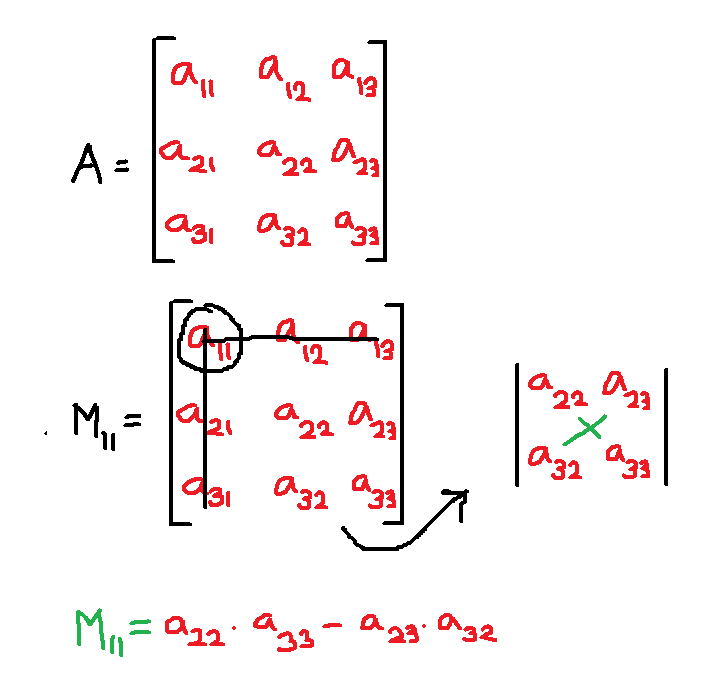
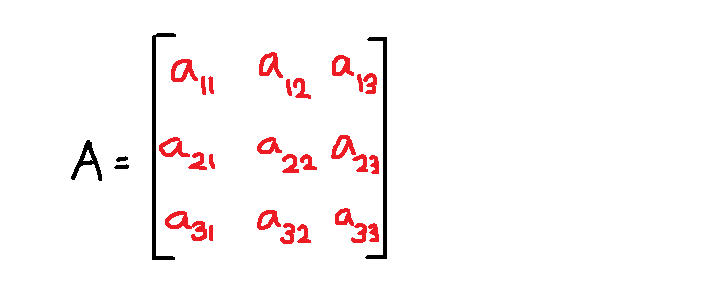
To find the minor you must follow these steps:
Step 1: Select an element to find its minor from the original matrix, for instance,  .
.
In the above matrix we have selected element  and its minor is
  .
.
Step 2: The next step is to cross out corresponding row and column that has element .
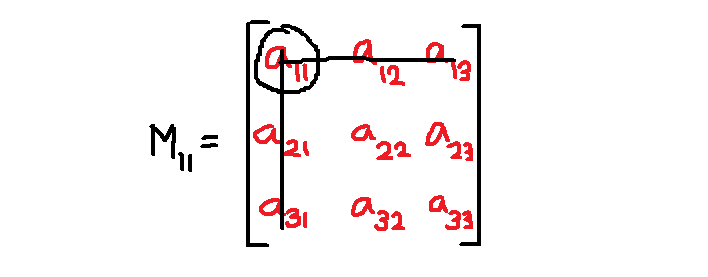

The element is in row  and column ; therefore, cross out row and column .
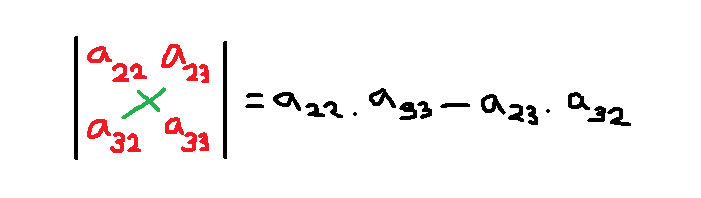
Step 3: Find the determinant of the smaller matrix obtained after step 2.
After step 2, we can use the remaining smaller matrix and do a cross multiplication to find the determinant. The determinant so obtained is the minor . There will be 9 minors for 9 elements of matrix A.
Construct Matrix of Minors
Once we have obtained minors all element of the matrix , arrange them as a matrix called matrix of minors.
Here we compute the matrix of minors from original matrix .
\begin{aligned}
&M_{11} = a_{22}.a_{33} - a_{23}.a_{32}= c_{11}\\
&M_{12} = a_{21}.a_{33} - a_{23}.a_{31}= c_{12}\\
&M_{13} = a_{21}.a_{32} - a_{22}.a_{31}= c_{13}\\\\
&M_{21} = a_{12}.a_{33} - a_{13}.a_{32}= c_{21}\\
&M_{22} = a_{11}.a_{33} - a_{13}.a_{31}= c_{22}\\
&M_{23} = a_{11}.a_{32} - a_{12}.a_{31}= c_{23}\\\\
&M_{31} = a_{12}.a_{23} - a_{13}.a_{22}=c_{31}\\
&M_{32} = a_{11}.a_{23} - a_{13}.a_{21}=c_{32}\\
&M_{33} = a_{11}.a_{22} - a_{12}.a_{21}=c_{33}\\\\
&= \begin{bmatrix}c_{11} & c_{12} & c_{13}\\c_{21} & c_{22} & c_{23}\\c_{31} & c_{32}& c_{33}\end{bmatrix}
\end{aligned}
A Few Examples
Q1: Find the minor for matrix and write the matrix of minors.
A= \begin{bmatrix}2 & -1\\4 & 5\end{bmatrix}Solution:
Given the following 2 x 2 matrix.
A= \begin{bmatrix}2 & -1\\4 & 5\end{bmatrix}If we select any element in matrix A and cross out the row and column corresponding there is only one element remains. But, remember that a single element is 1 x 1 square matrix and we have to find determinant of that single element.
\begin{aligned}
&M_{11} = |5| = 5\\
&M_{12} = |4| = 4\\
&M_{21} = |-1| = -1\\
&M_{22} = |2| = 2
\end{aligned}
The matrix of minors is,
= \begin{bmatrix}5 & 4\\-1 & 2\end{bmatrix}Q2: Find the minors for the following matrix.
A = \begin{bmatrix}2 & 1 & 3\\-3 & 5 & 1\\6 &2 & -5\end{bmatrix}Solution:
The Minors are,
\begin{aligned}
&M_{11} = 5 . -5 - 1 . 2 = -25 - 2 = -27\\
&M_{12} = -3 . -5 - 1 . 6 = 15 - 6 = 9\\
&M_{13} = -3 . 2 - 5 . 6 = -6 - 30 = -36\\\\
&M_{21} = 1 . -5 - 3 . 2 = -5 - 6 = -11\\
&M_{22} = 2 . -5 - 3 . 6 = -10 - 18 = -28\\
&M_{23} = 2 . 2 - 1 . 6 = 4 - 6 = -2\\\\
&M_{31} = 1 . 1 - 5 . 3 = 1 - 15 = -14\\
&M_{32} = 2 . 1 - (3) . (-3) = 2 + 9 = 11\\
&M_{33} = 2 . 5 - 1 . (-3) = 10 + 3 = 13
\end{aligned}
The matrix of minors is,
= \begin{bmatrix}-27 & 9 & -36\\-11 & -28 & -2\\-14 & 9 & 13\end{bmatrix}The minor so found is useful in finding cofactors and adjoint of a given square matrix. We shall also see that minor are useful tool in solving a system of linear equations by determinant method in future articles.
Finding Determinant By Cross Multiplication
In the previous article, we have seen how determinant decides whether a system of equation (read square matrix) has inverse, or it has a solution, only when the determinant is not zero. The determinant is obtained from the equation given below.
determinant = \sum \pm a_{1\alpha}a_{2\beta} \cdots a_{nv}To know more about finding determinant in this way , read previous article. Here we will discuss about finding determinant by cross multiplication but before that let us understand the different notations used to represent determinants.
Notation For Determinants
There are several notation for determinants given by earlier mathematicians. Suppose $A$ represents a augmented matrix from a system of linear equations, then determinant of $ A$ is given below.
Let the matrix $A$ be a 2 x 2 matrix.
A = \begin{bmatrix}a_{11} & a_{12}\\a_{21} & a_{22}\end{bmatrix}Different ways to represent determinant of matrix $A$.
\begin{aligned}
&det(A)    \hspace{1cm}(1)\\\\
&|A| \hspace{1cm}(2)\\\\
&\begin{vmatrix}a_{11} & a_{12}\\a_{21} & a_{22}\end{vmatrix} \hspace{1cm}(3)
\end{aligned}
Determinant as a Function
Imagine determinant to a function that take a square matrix as input and give a single value as output. For example,$f(x) = x^3$ be a function where $x$ could be any real number. Similarly, $latex det(A)&s=1$ is a function that matrix as input and give a determinant value $d$. The determinant value is always integer because it is linear combination of integers, that is, all values are integers in the matrix.
Determinant of $1 \times 1$ Matrix
If $A$ is a matrix with just one element, then its determinant is the same element.
Example #1
Let $A$ be a square matrix of order $1 \times 1$.
A = \begin{bmatrix}2\end{bmatrix}Then the determinant of $A$ is,
|A| = |2| = 2
Determinant of $ 2 \times 2$ Matrix
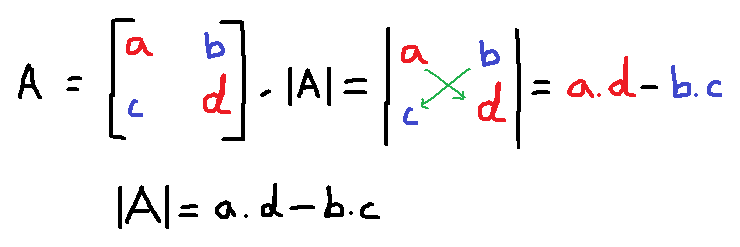
The determinant of a $2 \times 2$ matrix is obtained by performing cross multiplication. See the following figure.
Example #2
Let $A$ be a $2 \times 2$ square matrix. Find the determinant of the matrix $A$.
Solution:
Let the $A$ be 2 x 2 square matrix.
\begin{aligned}
&A = \begin{bmatrix}2 & 3\\1 & 5\end{bmatrix}\\\\
&|A| = a \times d - b \times c\\\\
&|A| = 2 \times 5 - 3 \times 1\\\\
&|A| = 10 - 3 = 7
\end{aligned}
Example #3
Let $B$ be a square matrix of order $2 \times 2$. Find the determinant of the matrix $B$.
Solution:
Let $B$ be a square matrix of order $2 \times 2$.
\begin{aligned}
&B = \begin{bmatrix}5 & -1\\4 & -3\end{bmatrix}\\\\
&|B| = a \times d - b \times c\\\\
&|B| = 5 \times (-3) - (-1) \times 4\\\\
&|B| = (-15) - (-4)\\\\
&|B| = (-15) + 4 = -11
\end{aligned}
Determinant Of $3 \times 3$ Matrix
The determinant of a $ 3 \times 3$ matrix is also possible through cross multiplication; Since we have a larger matrix we need to convert the larger matrix into smaller matrix to compute determinant. See figure below.
Step 1: Select the first row, first element and strike out rest of the elements from first row and first column. Then use to remaining element to create 2 x 2 matrix and find its determinant. See image below.
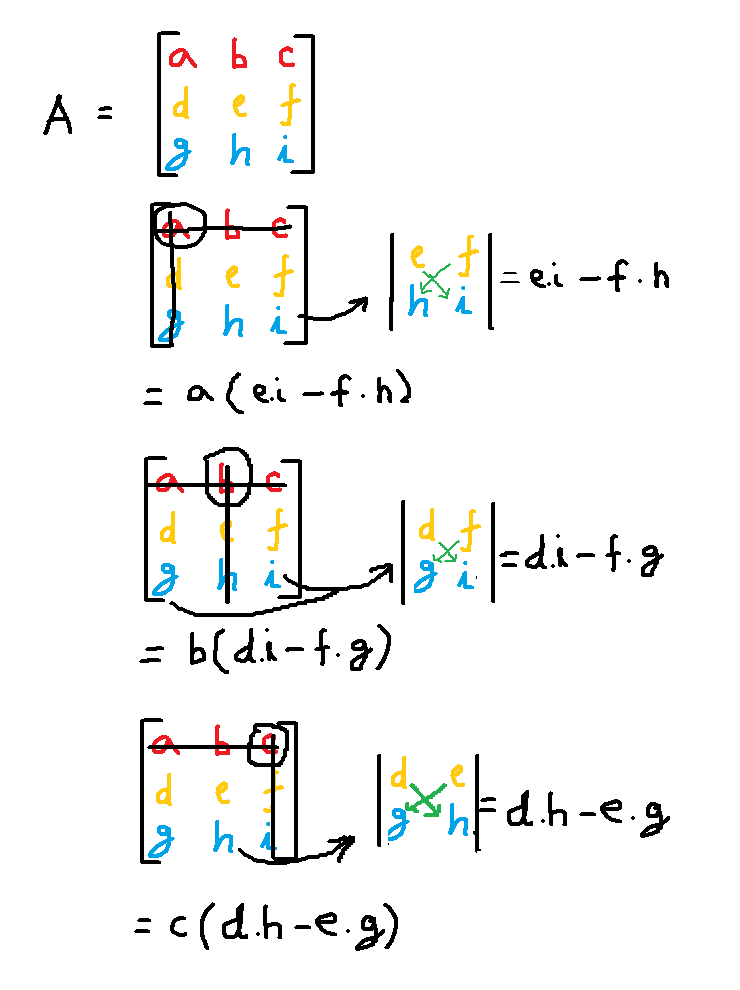
Each selected element must be multiplied with the respective 2 x 2 determinant obtained by eliminating 1st row and the respective column of selected element.
Step 2: Add all terms together and assign a negative or positive sign to each term.
If the selected element from top row (a b c) is $a$. then row $i = 1$ and column $j = 1$. Then the sign of first element
\begin{aligned}
&= (-1)^{i+j}a(ei - fh)\\\\
&= (-1)^{1 + 1}a(ei - fh)\\\\
&= (-1)^{2})a(ei - fh)\\\\
&= +a(ei - fh)\\\\
\end{aligned}
Similarly, second element from top row( a b c).
= -b(di - fg)
Third element from top row( a b c).
= +c(dh - eg)
Step 3: Write down the determinant function obtained previously.
The determinant of $3 \times 3$ matrix.
|A| = +a(ei - fh) - b(di - fg) + c(dh - eg)
Let us see few examples of determinant of $latex 3 \times 3&s=1$ matrices.
Example #4
Find the determinant of the following $3 \times 3$ matrix.
C = \begin{bmatrix}2 & 1 & 4\\5 & 3 & 7\\2 & 6 & 1\end{bmatrix}Solution:
Given matrix $C$, the determinant is following function.
\begin{aligned}
&C = \begin{bmatrix}2 & 1 & 4\\5 & 3 & 7\\2 & 6 & 1\end{bmatrix}\\\\
&|C| = a_{11}(a_{22}a_{33} - a_{23}a_{32}) - a_{12}(a_{21}a_{33} - a_{23}a_{31}) + a_{13}(a_{21}a_{32} - a_{22}a_{31})
\end{aligned}
Therefore,
\begin{aligned}
&|C| = 2(3 \times 1 - 7 \times 6) - 1(5 \times 1 - 7 \times 2) + 4(5 \times 6 - 3 \times 2)\\\\
&|C| = 2(3 - 42) - 1(5 - 14) + 4(30 - 6)\\\\
&|C| = 2(-39) - 1(-9) + 4(24)\\\\
&|C| = 2(-39) - 1(-9) + 4(24) = -78 +9 + 96\\\\
&|C| = 27
\end{aligned}
Example #5
Find the determinant of the following $3 \times 3$ matrix below.
A = \begin{bmatrix}-3 & 1 & -6\\2 &-1 & 5\\3 & 9 & 7\end{bmatrix}Solution:‘
Given matrix $3 \times 3$.
A = \begin{bmatrix}-3 & 1 & -6\\2 & -1 & 5\\3 & 9 & 7\end{bmatrix}The determinant is given by following function,
|A| = a_{11}(a_{22}a_{33} - a_{23}a_{32}) - a_{12}(a_{21}a_{33} - a_{23}a_{31}) + a_{13}(a_{21}a_{32} - a_{22}a_{31})Therefore,
\begin{aligned}
&|A| = -3((-1)\times 7 - 5 \times 9)- 1(2 \times 7 - 5 \times 3)+ (-6)(2 \times 9 - (-1)\times 3)\\\\
&|A| = -3((-7) - 45)- 1(14 - 15)+ (-6)(18 - (-3))\\\\
&|A| = -3(-52)+ 1 + (-6)(21) = 156 + 1 -126\\\\
&|A| = 31
\end{aligned}
Note that the bigger the matrix , we must find more smaller matrices of size 2 x 2 and its determinant and then add all to get the determinant of original matrix. The process of finding the determinant of smaller matrices and making a matrix of determinants in called matrix of minors.
We shall discuss more about it in the next article.
Introduction To Determinants
Determinants are very important concept related to square matrix, and usually it is simple to calculate one while dealing with the system of linear equations. Our attempt here is to understand determinants properly so that all related concepts becomes easy and unforgettable. So we begin with a gentle introduction to determinants of matrices.
What are Determinants ?
Imagine there are no matrices and you must solve the system of linear equation with simple algebra. For example,
Consider the following system of linear equation with just one equation.
a_{11}x_1 = b_1 To solve this equation using algebra method divide both sides by constant .
x_1 = b_1/a_{11}The element is the determinant in the equation as a denominator. Provided  . Otherwise, the system has no solution.
A determinant is zero does not always means that the system of linear equation has no solution, sometimes it has infinite solutions. But, if determinant is 0, then the matrix is not invertible.
Let us take another example, where there are two linear system of equations with two unknowns.
\begin{aligned}
&a_{11}x_1 + a_{12}x_2 = b_1\\\\
&a_{21}x_1 + a_{22}x_2 = b_2
\end{aligned}
When we solve for  the equations become
\begin{aligned}
&x_1 = (b_1 - a_{12}x_2)/a_{11}\\\\
&x_1 = (b_2 - a_{22}x_2)/a_{21}
\end{aligned}
Comparing both equations we get,
\begin{aligned}
&x_1 = a_{21}b_1 - a_{12}a_{21} = a_{11}b_2 - a_{11}a_{22}\\\\
&= a_{21}b_1 - a_{11}b_2 = a_{12}a_{21} - a_{11}a_{22}\\\\
&= (a_{21}b_1 - a_{11}b_2)/(a_{12}a_{21} - a_{11}a_{22})
\end{aligned}
The denominator should be  , else the equation will collapse.
Generalizing the Denominator
From the above result, there is a pattern to the denominator and if you solve for  then you will find out that the denominator is not changing and it remain the same. Hence, the denominator is determinant of the equation given that it is not equal to zero.
For a system of two equations and two unknowns , the determinant is the following.
a_{12}a_{21} - a_{11}a_{22}Observe that in any term of determinant, the  corresponds to sequence of numbers
  and all in the term is a permutation of the sequence
  . Therefore, we could generalize determinant as
= \sum \pm a_{1\alpha}a_{2\beta}...a_{nv} where  determines the number of variables in a term.
Problem Of Negative And Positive Terms
Though we were able to generalize any term of the determinant with  variables in each term. Some terms are positive and some are negative. The next question is to determine which are positive and which are negative terms where any single terms is given by the following.
= \sum \pm a_{1\alpha}a_{2\beta}...a_{nv}Before that you need to be familiar with following concepts.
Inversion and Transposition
In the determinant term,  in natural order and all are a permutation of the natural order (1,2,3,…,n).
Given a permutation  if two indices are out of their natural order and greater index comes first and then lesser index, then it is called inversion.
Suppose that the natural order is  and the permutation is
  , here
  and is inversion as they are out of the natural order.
Suppose that the natural order is disturbed by swapping two numbers. If  is the permutation then only
  and
and  is swapped. This is called transposition.
The number of inversion is unique and can be counted. If the inversions are even then permutation  belongs to even class, otherwise, odd class.
If a term belongs to odd class, then assign negative sign, else assign a positive sign if it belongs to even class.
Determinant of 3 x 3 Equations
Using the information above let us systematically find determinant of equations. Since,  there will be
  terms with each term having 3 variables that is, .
Write down each permutation and the term of determinant.
\begin{aligned}
&a_{11}a_{22}a_{33}  \hspace{5px} //permutation \hspace{5px} of \hspace{5px} j \hspace{5px} is\hspace{5px} (1 2 3)\\\\
&a_{11}a_{23}a_{32} \hspace{5px} //permutation \hspace{5px}of \hspace{5px} j \hspace{5px} is \hspace{5px} (1 3 2)\\\\
&a_{12}a_{21}a_{33} \hspace{5px} //permutation \hspace{5px}of \hspace{5px} j \hspace{5px} is \hspace{5px}(2 1 3)\\\\
&a_{12}a_{23}a_{31} \hspace{5px} //permutation \hspace{5px} of \hspace{5px} j \hspace{5px}is \hspace{5px} (2 3 1)\\\\
&a_{13}a_{21}a_{32} \hspace{5px} //permutation \hspace{5px} of \hspace{5px} j \hspace{5px} is \hspace{5px} (3 1 2)\\\\
&a_{13}a_{22}a_{31} \hspace{5px} //permutation \hspace{5px} of \hspace{5px} j \hspace{5px} is \hspace{5px} (3 2 1)
\end{aligned}
We get following,
a_{11}a_{22}a_{33}+a_{11}a_{23}a_{32}+a_{12}a_{21}a_{33}+a_{12}a_{23}a_{31}a_{13}a_{21}a_{32}+a_{13}a_{22}a_{31}We must look at the permutation and change the sign of terms that belong to odd class meaning permutations that have odd number of inversions.
= a_{11}a_{22}a_{33}-a_{11}a_{23}a_{32}-a_{12}a_{21}a_{33}+a_{12}a_{23}a_{31}a_{13}a_{21}a_{32}-a_{13}a_{22}a_{31}This is a faster method of finding determinants, but you must be careful in checking the number of inversions. Next article, we shall discuss about finding determinants by cross multiplications and some interesting properties of determinants.
Linear Algebra – Theory, Examples, and Practice Problems
Linear Algebra is a core subject in Mathematics for Computer Science, Information Technology, Engineering, and Science curricula. It plays a crucial role in GATE, UGC NET, and university semester examinations, forming the foundation for problem-solving and analytical thinking.
On this page, you will find structured learning resources for Linear Algebra, with clear explanations, worked examples, and exam-oriented revision material.
What Will You Learn?
On this page, you will find:
- Core Linear Algebra concepts explained step by step
- Problem-solving techniques with solved examples
- Exam-oriented explanations for competitive and university exams
- Practice problems and MCQ-based questions
- Detailed articles along with exam-ready revision PDFs
This Page Is For:
- Computer Science, IT, and Engineering students
- GATE, UGC NET, and other competitive exam aspirants
- University semester exam preparation
- Self-learners who want to understand, practice, and revise Linear Algebra
Topic Sections
Find Linear Algebra topics organized chapter-wise and concept-wise below.
(1) Introduction to Linear Algebra
(2) Systems of Linear Equations
- System Of Linear Equations
- Inconsistent Linear System
- Types Of Matrices
- Elementary Row Operations
- Row Echelon Form
- Gauss Elimination
- Homogenous System Of Linear Equations
(3) The Simplex Method
(4) Vector Spaces
(5) Linear Transformations
(6) Matrices
- Find Inverse Matrix
- Inverse Diagonal Matrix
- Inverse Of Triangular Matrices
- Matrix Operations
- Matrix Addition
- Matrix Subtraction
- Matrix Multiplication
- Matrix Transpose
- Trace Of Matrix
- Power Of Matrices
- Inverse Of Matrix
(7) Determinants
- Finding Determinant
- Introduction To Determinants
- Finding Matrix Of Minors
- Cofactors Of Matrix
- Adjoint Of Square Matrix
- Solving Systems of Linear Equations using Cramer’s Rule
(8) Subspaces and Spanning Sets
(9) Linear Independence
(10) Basis and Dimensions
(11) Eigenvalues and Eigenvectors
(12) Diagonalization
(13) Orthonormal Bases and Complements
(14) Diagonalizing Symmetric Matrices
(15) Kernel, Range, Nullity, Rank
(16) Least Squares and Singular Values
more topics coming soon …
Inverses Of Triangular Matrices
Triangular matrices are diagonal matrix plus some elements on the upper side or lower side of the main diagonal. Here we discuss about types, interesting properties of triangular matrix. Later we will find ways to determine the invertibility and how to find inverse of a triangular matrix with examples.
What Are Triangular Matrices ?
If a square matrix has all zeros below its main diagonal entries then it is called upper triangular matrix and if the square matrix has all zeros above the main diagonal entries then it is called lower triangular matrix. Therefore, a triangular matrix has either all zero entries above or below main diagonal.
Examples of Upper Triangular Matrix
\begin{aligned}
&A = \begin{bmatrix}a_{11} & a_{12}\\0 & a_{22}\end{bmatrix}\\\\
&B = \begin{bmatrix}a_{11} & a_{12}& a_{13}\\0 & a_{22}& a_{23}\\0 & 0 & a_{33}\end{bmatrix}\\\\
&C = \begin{bmatrix}2 & 1 & 9 & 3\\0 & -1 & 8 &-2\\0 & 0 & -7 & 5\\0& 0 & 0 & 4\end{bmatrix}
\end{aligned}
Examples of Lower Triangular Matrix
\begin{aligned}
&P = \begin{bmatrix}a_{11} & 0\\a_{12} & a_{22}\end{bmatrix}\\\\
&Q = \begin{bmatrix}a_{11} & 0& 0\\a_{21} & a_{22}& 0\\a_{31} & a_{32} & a_{33}\end{bmatrix}\\\\
&R = \begin{bmatrix}-1 & 0 & 0 & 0\\5 & 1 & 0 &0\\-3 & 1 & -7 & 0\\8& 2 & -6 & 2\end{bmatrix}
\end{aligned}
Rules Regarding Triangular Matrices
Here are some basic rules regarding the upper or lower triangular matrices.
- If a square matrix
![A= [a_{ij}]](data:image/svg+xml;base64,PHN2ZyB4bWxucz0iaHR0cDovL3d3dy53My5vcmcvMjAwMC9zdmciIHdpZHRoPSI2NiIgaGVpZ2h0PSIxOSIgdmlld0JveD0iMCAwIDY2IDE5Ij48cmVjdCB3aWR0aD0iMTAwJSIgaGVpZ2h0PSIxMDAlIiBzdHlsZT0iZmlsbDojY2ZkNGRiO2ZpbGwtb3BhY2l0eTogMC4xOyIvPjwvc3ZnPg== "Rendered by QuickLaTeX.com") is upper triangular matrix then
is upper triangular matrix then  and
and  .
. - If a square matrix is lower triangular matrix then and .
- If a square matrix is upper triangular matrix then
 row has and starts with
  zeros.
 - If a square matrix is lower triangular matrix then row has and starts with
 zeros.
![A= [a_{ij}]](https://notesformsc.org/wp-content/ql-cache/quicklatex.com-7f076d74750b3d1384cd7ce5883a7eb0_l3.png "Rendered by QuickLaTeX.com") is upper triangular matrix then
is upper triangular matrix then  and
and  .
. .
. row has and starts with
  zeros.
 zeros.
Strict Triangular Matrix
A strict triangular matrix is a square matrix which has all entries zero below or above the main diagonal including the main diagonal.
Strict Upper Triangular Matrix
If a strict triangular matrix has all zero entries below the main diagonal including the main diagonal then it is called strict upper triangular matrix.
Example of Strict Upper Triangular Matrix
\begin{aligned}
&A = \begin{bmatrix}0 & b\\0 & 0\end{bmatrix}\\\\
&B = \begin{bmatrix}0 & 4 & 2\\0 & 0 & 1\\0 & 0 & 0\end{bmatrix}
\end{aligned}
Examples of Strict Lower Triangular Matrix
\begin{aligned}
&C = \begin{bmatrix}0 & 0\\c & 0\end{bmatrix}\\\\
&D = \begin{bmatrix}0 & 0 & 0\\7 & 0 & 0\\3 & 9 & 0\end{bmatrix}
\end{aligned}
The basic rules for constructing strict upper or strict lower triangular matrix are
- If a square matrix is strict upper triangular matrix when and .
- If a square matrix is strict lower triangular matrix when and .
![A = [a_{ij}]](https://notesformsc.org/wp-content/ql-cache/quicklatex.com-225992b3722a8cd74c51719d967f6b9e_l3.png "Rendered by QuickLaTeX.com") is strict upper triangular matrix when
is strict upper triangular matrix when  .
. .
.Properties Of Triangular Matrix
There are some interesting properties of triangular matrices which we will explore each type of triangular matrices with examples.
Properties of Upper Triangular Matrices
The upper triangular matrix is in row-echelon form. Here are the properties of upper triangular matrices.
- Adding two upper triangular matrices of same order will result in a upper triangular matrix of same order.
- Product of two defined ( eligible for multiplication) upper triangular matrices is upper triangular matrix.
- Transpose of upper triangular matrix is lower triangular matrix.
- Inverse of upper triangular matrix is also upper triangular matrix.
Let us verify each claim with examples.
Addition of Two Upper Triangular Matrices
Let and  be two upper triangular matrices of order .
\begin{aligned}
&A = \begin{bmatrix}2 & 3 & 5\\0 & 3 & 6\\0 & 0 & 1\end{bmatrix} \hspace{5px} B = \begin{bmatrix}6 & 1 & 7\\0 & 4 & 1\\0 & 0 & 8\end{bmatrix}\\\\
&A + B = \begin{bmatrix}8 & 4 & 12\\0 & 7 & 7\\0 & 0 & 9\end{bmatrix}
\end{aligned}
Therefore, sum of two upper triangular matrices is an upper triangular matrix.
Product of Two Upper Triangular Matrix
Let  and be two matrices of order .
\begin{aligned}
&C = \begin{bmatrix}2 & 7\\0 & 4\end{bmatrix}\\\\
&D = \begin{bmatrix}1 & 3\\0 & 5\end{bmatrix}
\end{aligned}
Let the product of  .
.
\begin{aligned}
&K = \begin{bmatrix}2+0 & 6+35\\0+0 & 0+20\end{bmatrix}\\\\
&K = \begin{bmatrix}2 & 41\\0 & 20\end{bmatrix}
\end{aligned}
The product of two defined upper triangular matrices is an upper triangular matrix.
Transpose of Upper Triangular Matrix
The transpose of a matrix can be obtained by changing all rows into columns or all columns into rows.
A = \begin{bmatrix}a & b & c\\0 & d & e\\0 & 0 & f\end{bmatrix}Then the transpose of matrix is
A^T = \begin{bmatrix}a & 0 & 0\\b & d & 0\\c & e & f\end{bmatrix}Inverse of Upper Triangular Matrix
Like diagonal matrix, if the main diagonal of upper triangular matrix is non-zero then it is invertible. To be invertible a square matrix must has determinant not equal to 0. Since, determinant of a upper triangular matrix is product of diagonals if it is nonzero, then the matrix is invertible.
Let be a upper triangular matrix of order .
A = \begin{bmatrix}2 & 5\\0 & 3\end{bmatrix} The determinant is nonzero, therefore, matrix is invertible.
\begin{aligned}
&|A| = 2 \times 3 = 6\\\\
&A^{-1} = 1/6 \times \begin{bmatrix}3 & -5\\0 & 2\end{bmatrix}\\\\
&A^{-1} = \begin{bmatrix}1/2& -5/ 6\\0 &1/3\end{bmatrix}
\end{aligned}
Properties of Lower Triangular Matrices
The properties of lower triangular matrices are similar to that of upper triangular matrices,but we decided to discuss it separately. Here are the basic properties
- Adding two lower triangular matrices of same order will result in a lower triangular matrix of same order.
- Product of two defined ( eligible for multiplication) lower triangular matrices is lower triangular matrix.
- Transpose of lower triangular matrix is upper triangular matrix.
- Inverse of lower triangular matrix is also lower triangular matrix.
Let us verify each statement with examples.
Addition of Lower Triangular Matrix
Let and be two lower triangular matrices of order .
A = \begin{bmatrix}2 & 0 & 0\\4 & 1 & 0\\3 & 9 & 5\end{bmatrix} \hspace{5px} B = \begin{bmatrix}-3 & 0 & 0\\-2 & 7 & 0\\-1 & 6 & 1\end{bmatrix}The addition of matrix is stored in matrix .
\begin{aligned}
&C = A + B\\\\
&C = \begin{bmatrix}2 & 0 & 0\\4 & 1 & 0\\3 & 9 & 5\end{bmatrix} + \begin{bmatrix}-3 & 0 & 0\\-2 & 7 & 0\\-1 & 6 & 1\end{bmatrix}\\\\
&C = \begin{bmatrix}-1 & 0 & 0\\2 & 8 & 0\\2 & 15 & 6\end{bmatrix}
\end{aligned}
Therefore, above results shows that sum of two lower triangular matrix is a lower triangular matrix of same order.
Product of Two Lower Triangular Matrix
Similar to upper triangular matrix, the product of two defined lower triangular matrix is a lower triangular matrix.
Let and  be two lower triangular matrix of order and the product matrix is of same order.
\begin{aligned}
&A = \begin{bmatrix}6 & 0 & 0\\2 & 7 & 0\\1 & 9 & 3\end{bmatrix} \hspace{5px} B = \begin{bmatrix}-1 & 0 & 0\\5 & 3 & 0\\-3 & 2 & -5\end{bmatrix}\\\\
&C = A \times B\\\\
&C = \begin{bmatrix}-6 & 0 & 0\\33 & 21 & 0\\35 & 33 & -15\end{bmatrix}
\end{aligned}
Transpose of Lower Triangular Matrix
The transpose of lower triangular matrix will change all rows to columns or columns to rows which result in an upper triangular matrix. Consider the following example.
Let  be a lower triangular matrix of order
  . The transpose of matrix is denoted as
  .
.
S = \begin{bmatrix}2 & 0 & 0 & 0\\7 & 5 & 0 & 0\\1 & 3 & 2 & 0\\4 & 9 & 6 & 8\end{bmatrix}Transpose of matrix .
S^T = \begin{bmatrix}2 & 7 & 1 & 4\\0 & 5 & 3 & 9\\0 & 0 & 2 & 6\\0 & 0 & 0 & 8\end{bmatrix}Inverse of Lower Triangular Matrix
The invertibility requirement of lower triangular matrix is same as that of upper triangular matrix. The main diagonal element should not be zero because the determinant of the lower triangular matrix must not be a zero; otherwise there is no inverse matrix.
Let  be a lower triangular matrix of order .
L = \begin{bmatrix}2 & 0 & 0 &0\\3 & 1 & 0 & 0\\2 & 5 & 6 & 0\\4 & 3 & 2 & 7\end{bmatrix}Since the diagonals are non-zero, the matrix is invertible and its determinant is  .
.
|L| = 2 \times 1 \times 6 \times 7 = 84
The minor matrix of .
\begin{aligned}
&M_{11} = \begin{vmatrix}1 & 0 & 0\\5 & 6 & 0\\3 & 2 & 7\end{vmatrix} = 42, M_{12} = \begin{vmatrix}3 & 0 & 0\\2 & 6 & 0\\4 & 2 & 7\end{vmatrix} = 126\\\\
&M_{13} = \begin{vmatrix}3 & 1 & 0\\2 & 5 & 0\\4 & 3 & 7\end{vmatrix} = 91, M_{14} = \begin{vmatrix}3 & 1 & 0\\2 & 5 & 6\\4 & 3 & 2\end{vmatrix} = -4\\\\
&M_{21} = \begin{vmatrix}0 & 0 & 0\\5 & 6 & 0\\3 & 2 & 7\end{vmatrix} = 0,  M_{22} = \begin{vmatrix}2 & 0 & 0\\2 & 6 & 0\\4 & 2 & 7\end{vmatrix} = 84\\\\
&M_{23} = \begin{vmatrix}2 & 0 & 0\\2 & 5 & 0\\4 & 3 & 7\end{vmatrix} = 70,  M_{24} = \begin{vmatrix}2 & 0 & 0\\2 & 5 & 6\\4 & 3 & 2\end{vmatrix} = -16\\\\
&M_{31} = \begin{vmatrix}0 & 0 & 0\\1 & 0 & 0\\3 & 2 & 7\end{vmatrix} = 0,  M_{32} = \begin{vmatrix}2 & 0 & 0\\3 & 0 & 0\\4 & 2 & 7\end{vmatrix} = 0\\\\
&M_{33} = \begin{vmatrix}2 & 0 & 0\\3 & 1 & 0\\4 & 3 & 7\end{vmatrix} = 14,  M_{34} = \begin{vmatrix}2 & 0 & 0\\3 & 1 & 0\\4 & 3 & 2\end{vmatrix} = 4\\\\
&M_{41} = \begin{vmatrix}0 & 0 & 0\\1 & 0 & 0\\5 & 6 & 0\end{vmatrix} = 0,  M_{42} = \begin{vmatrix}2 & 0 & 0\\3 & 0 & 0\\2 & 6 & 0\end{vmatrix} = 0\\\\
&M_{43} = \begin{vmatrix}2 & 0 & 0\\2 & 5 & 0\\4 & 3 & 7\end{vmatrix} = 0, M_{44} = \begin{vmatrix}2 & 0 & 0\\3 & 1 & 0\\2 & 5 & 6\end{vmatrix} = 12\\\\
&= \begin{bmatrix}42 & 126 & 91 & -4\\0 & 84 & 70 & -16\\0 & 0 & 14 & 4\\0 & 0 & 0 & 12\end{bmatrix}
\end{aligned}
From the minor matrix we can obtain the cofactor matrix. Each cofactor value can be obtained using
\begin{aligned}
&L_{ij} = (-1)^{i+j} \times M_{ij}\\\\
&= \begin{bmatrix}42 & -126 & 91 & 4\\0 & 84 & -70 & -16\\0 & 0 & 14 & -4\\0 & 0 & 0 & 12\end{bmatrix}
\end{aligned}
The adjoint matrix can be obtained from the cofactor matrix and we can find the inverse of the matrix.
Adj \hspace{3px} L = \begin{bmatrix}42 & 0 & 0 & 0\\-126 & 84 & 0 & 0\\91 & -70 & 14 & 0\\4 & -16 & -4 & 12\end{bmatrix} Therefore, The inverse of matrix is  and obtained using
\begin{aligned}
&L^{-1} = 1/84 \times Adj \hspace{3px}L\\\\
&L^{-1} = 1/84 \times \begin{bmatrix}42 & 0 & 0 & 0\\-126 & 84 & 0 & 0\\91 & -70 & 14 & 0\\4 & -16 & -4 & 12\end{bmatrix}\\\\
&L^{-1} = \begin{bmatrix}1/2& 0 & 0 & 0\\ -3/2& 1 & 0 & 0\\91/84&-5/6&1/6& 0\\1/21& -4/21& -1/ 21&1/7\end{bmatrix}
\end{aligned}
Therefore, lower triangular matrix has a lower triangular inverse matrix. Let us verify the inverse matrix.
\begin{aligned}
&L \times L^{-1} = I\\\\
&= \begin{bmatrix}2 & 0 & 0 &0\\3 & 1 & 0 & 0\\2 & 5 & 6 & 0\\4 & 3 & 2 & 7\end{bmatrix} \times \begin{bmatrix}1/2& 0 & 0 & 0\\ -3/2& 1 & 0 & 0\\91/84&-5/6 &1/6& 0\\1/21& -4/21& -1/21&1/7\end{bmatrix}\\\\
&= \begin{bmatrix}1 & 0 & 0 &0\\0 & 1 & 0 & 0\\0 & 0 & 1 & 0\\0 & 0 & 0 & 1\end{bmatrix}
\end{aligned}
In the next article, we will discuss some interesting way to solve Ax = b using triangular matrices.
Inverse Of Diagonal Matrix
The diagonal matrix has diagonal elements only and if the diagonals are 1 then the matrix is called and identity matrix  . In this article, we discuss about diagonal matrix and properties. Then find the inverse of diagonal matrix.
What is a diagonal matrix ?
A diagonal matrix is a matrix whose diagonal entries are non-zero and all other entries are zero. For example,
A = \begin{bmatrix}a_{11}&0&0\\0&a_{22}&0\\0&0&a_{33}\end{bmatrix}The matrix above is a diagonal matrix whose diagonal entries are  and other entries are
  .
.
Some Interesting Properties of Diagonal Matrix
The diagonal matrix have some interesting properties explain in this section with examples.
Addition Or Multiplication of Diagonal Matrices
Addition or multiplication of two or more diagonal matrices of same order will give a diagonal matrix of same order.
Example #1
Let and be two diagonal matrices of order .
A = \begin{bmatrix}2 & 0 & 0 \\0 & 7 & 0\\0 & 0 & 4\end{bmatrix} B = \begin{bmatrix}1 & 0 & 0 \\0 & 3 & 0\\0 & 0 & 5\end{bmatrix}Therefore, adding and will give
A + B = C
C_{3\times3} = \begin{bmatrix}2 + 1 & 0 + 0 & 0 + 0\\0 + 0 & 7 + 3& 0+0\\ 0+0& 0 + 0&4+ 5\end{bmatrix} = \begin{bmatrix}3 & 0 & 0 \\0 & 10 & 0\\0 & 0 & 9\end{bmatrix}_{3\times3}Example #2
Let and be two diagonal matrices of order .
C = \begin{bmatrix}4 & 0\\0 & 3\end{bmatrix}\hspace{5px} D =\begin{bmatrix} 1 & 0\\0 & 6\end{bmatrix}Therefore, multiplying matrix and will give
C \times D = F
\begin{aligned}
F_{2\times2} = \begin{bmatrix}4 + 0 & 0 + 0\\0 + 0&0 + 18\end{bmatrix}= \begin{bmatrix}4 & 0\\0 & 18\end{bmatrix}_{2\times2}
\end{aligned}
Multiplication Of Diagonal Matrix With Other Matrices
Let be matrix of order and be a matrix of order  .
.
Example #3
\begin{aligned}
&A = \begin{bmatrix}a_{11}&0&0\\0&a_{22}&0\\0&0&a_{33}\end{bmatrix}\\\\
&B = \begin{bmatrix}b_{11}&b_{12}\\b_{21}&b_{22}\\b_{31}&b_{32}\end{bmatrix}\\\\
&A \times B = \begin{bmatrix}a_{11}&0&0\\0&a_{22}&0\\0&0&a_{33}\end{bmatrix} \times \begin{bmatrix}b_{11}&b_{12}\\b_{21}&b_{22}\\b_{31}&b_{32}\end{bmatrix}\\\\
&A \times B = \begin{bmatrix}a_{11}b_{11}&a_{11}b_{12}\\a_{22}b_{21}&a_{22}b_{22}\\a_{33}b_{31}&a_{33}b_{32}\end{bmatrix}
\end{aligned}
Each element of diagonal matrix is multiplied with corresponding row elements of matrix . For example, element from diagonal matrix is multiplied with all elements of first row in matrix .
Example #4
Another case of multiplication is when matrix of order  is multiplied with a diagonal matrix of order .
Let be a matrix of order  .
.
C = \begin{bmatrix}c_{11}&c_{12}&c_{13}\\c_{21}&c_{22}&c_{23}\\c_{31}&c_{32}&c_{33}\\c_{41}&c_{42}&c_{43}\end{bmatrix} and be a diagonal matrix of order
\begin{aligned}
&A = \begin{bmatrix}a_{11}&0&0\\0&a_{22}&0\\0&0&a_{33}\end{bmatrix}\\\\
&C \times A = \begin{bmatrix}c_{11}&c_{12}&c_{13}\\c_{21}&c_{22}&c_{23}\\c_{31}&c_{32}&c_{33}\\c_{41}&c_{42}&c_{43}\end{bmatrix}\times \begin{bmatrix}a_{11}&0&0\\0&a_{22}&0\\0&0&a_{33}\end{bmatrix}\\\\
&C \times A = \begin{bmatrix}c_{11}a_{11}+0+0&0+c_{12}a_{22}+0&0+0+c_{13}a_{33}\\c_{21}a_{11}+0+0&0+c_{22}a_{22}+0&0+0+c_{23}a_{33}\\c_{31}a_{11}+0+0&0+c_{32}a_{22}+0&0+0+c_{33}a_{33}\\c_{41}a_{11}+0+0&0+c_{42}a_{22}+0&0+0+c_{43}a_{33}\end{bmatrix}\\\\
&C \times A = \begin{bmatrix}c_{11}a_{11}&c_{12}a_{22}&c_{13}a_{33}\\c_{21}a_{11}&c_{22}a_{22}&c_{23}a_{33}\\c_{31}a_{11}&c_{32}a_{22}&c_{33}a_{33}\\c_{41}a_{11}&0+c_{42}a_{22}&c_{43}a_{33}\end{bmatrix}
\end{aligned}
When matrix is multiplied with diagonal matrix then each element of is multiplied with corresponding columns in matrix . For example, element is multiplied with first column of the matrix .
Commutative Property of Multiplication in Between Diagonal Matrices
If two matrices and are diagonal matrices of same order , then the multiplication is commutative.
Example #5
Let be a diagonal matrix of order .
A = \begin{bmatrix}3&0&0\\0&4&0\\0&0&5\end{bmatrix}and be a diagonal matrix of order .
\begin{aligned}
&A = \begin{bmatrix}-2&0&0\\0&1&0\\0&0&7\end{bmatrix}\\\\
&A \times B = \begin{bmatrix}3&0&0\\0&4&0\\0&0&5\end{bmatrix} \times \begin{bmatrix}-2&0&0\\0&1&0\\0&0&7\end{bmatrix}\\\\
&A \times B = \begin{bmatrix}-6&0&0\\0&4&0\\0&0&35\end{bmatrix}
\end{aligned}
Similarly,
\begin{aligned}
&B \times A = \begin{bmatrix}-2&0&0\\0&1&0\\0&0&7\end{bmatrix}\times \begin{bmatrix}3&0&0\\0&4&0\\0&0&5\end{bmatrix}\\\\
&A \times B = \begin{bmatrix}-6&0&0\\0&4&0\\0&0&35\end{bmatrix}
\end{aligned}
Therefore,  for diagonal matrices is true.
Diagonal Matrix is Symmetric
If is a diagonal matrix of order then it is symmetric.
A = A^T
Example #6
Let be a diagonal matrix of order .
A = \begin{bmatrix}a_{11}&0&0&0\\0&a_{22}&0&0\\0&0&a_{33}&0\\0&0&0&a_{44} \end{bmatrix}When we take transpose of a matrix, then becomes  , but for a diagonal matrix
  , therefore,
\begin{aligned}
&A^T = \begin{bmatrix}a_{11}&0&0&0\\0&a_{22}&0&0\\0&0&a_{33}&0\\0&0&0&a_{44} \end{bmatrix} = A\\\\
&A = A^T
\end{aligned}
We conclude that the diagonal matrix is symmetric and  is true.
Power of Diagonal Matrix
If a diagonal matrix  is multiplied by itself k-times, then we can say that the matrix is raised to the power of
  .
.
Example #7
Let be a diagonal matrix of order . Let matrix is raised to power  then
then
\begin{aligned}
&P^3 = \begin{bmatrix}a & 0\\0 & b\end{bmatrix} \times \begin{bmatrix}a & 0\\0 & b\end{bmatrix}\times \begin{bmatrix}a & 0\\0 & d\end{bmatrix}\\\\
&P^3 = \begin{bmatrix}a^3 & 0\\0 & b^3\end{bmatrix}
\end{aligned}
Therefore,
P^k = \begin{bmatrix}a^k & 0\\0 & b^k\end{bmatrix}Invertible Diagonal Matrix
Any matrix is invertible if its determinant is not equal to 0 and it is a square matrix. The diagonal matrix is a square matrix, but it must have a non-zero entry in the main diagonal to be invertible.
If the main diagonal has a zero entry then it is a singular matrix for two reasons
- It is not a square matrix
- It has a zero determinant
Example #8
Let matrix be a diagonal matrix of order .
A = \begin{bmatrix} a & 0 & 0\\0 & b & 0\\0 & 0 & 0\end{bmatrix}Rule 1: Diagonal matrix must be a square matrix.
The last row of matrix is zero and must be deleted. The remaining two row is not a square matrix; therefore, not invertible.
Rule 2: The determinant of matrix should be non-zero.
The minor matrix of is
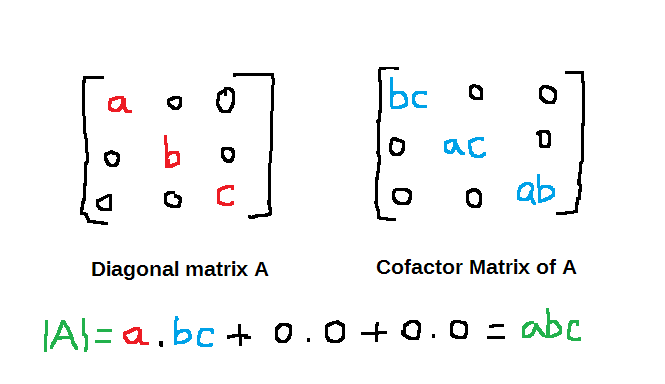
= \begin{bmatrix}0 & 0 &0\\0 & 0 & 0\\0 & 0 & ab\end{bmatrix}The determinant of a diagonal matrix is  if there are non-zero elements in the main diagonal.
Inverse of a Diagonal Matrix
The inverse of a diagonal matrix can be found by using the following equation.
A^{-1} = 1/|A|\times adj AExample #9
Let be a diagonal matrix of order .
A = \begin{bmatrix}a & 0 & 0\\0 & b & 0\\0 & 0 & c\end{bmatrix}From the discussion above we know that the co-factor matrix of A is
= \begin{bmatrix}bc & 0 & 0\\0 & ac & 0\\0 & 0 & bc\end{bmatrix} Since, matrix is symmetric, that is, .
Let be a diagonal matrix of order .
A = \begin{bmatrix}a & 0 & 0\\0 & b & 0\\0 & 0 & c\end{bmatrix}From the discussion above we know that the co-factor matrix of A is
= \begin{bmatrix}bc & 0 & 0\\0 & ac & 0\\0 & 0 & bc\end{bmatrix}Since, matrix is symmetric, that is, .
adj A = \begin{bmatrix}A_{ij}\end{bmatrix}^T = \begin{bmatrix}bc & 0 & 0\\0 & ac & 0\\0 & 0 & bc\end{bmatrix}Therefore,
\begin{aligned}
&A^{-1} = 1/abc\times \begin{bmatrix}bc & 0 & 0\\0 & ac & 0\\0 & 0 & bc\end{bmatrix}\\\\
&A^{-1} = \begin{bmatrix}1/a& 0 & 0\\0 &1/b& 0\\0 & 0 &1/c\end{bmatrix}
\end{aligned}
From the example it is clear that the inverse of a diagonal matrix  contains reciprocal of each element of the diagonal matrix .
‘Example #10
Find the inverse of following diagonal matrix .
B = \begin{bmatrix}-3 & 0 & 0 \\0 & 2 & 0 \\ 0 & 0 & 5\end{bmatrix}Solution :
Given the diagonal matrix .
B = \begin{bmatrix}-3 & 0 & 0 \\0 & 2 & 0 \\ 0 & 0 & 5\end{bmatrix}We simply need to find the inverse of each diagonal element in the matrix .
Therefore,
B^{-1} = \begin{bmatrix}-1/3& 0 & 0 \\0 &1/2& 0 \\ 0 & 0 &1/5\end{bmatrix}Important Points To Remember
Here are some important points to remember.
- diagonal addition and multiplication with another diagonal matrix is commutative.
- diagonal matrix is symmetric.
- power of diagonal matrix is power of individual diagonal entries.
- invertible diagonal matrix has non-zero diagonal entries.
- inverse of a diagonal matrix is a matrix that has inverse of each corresponding element from the diagonal matrix.
How To Find Inverse Of A Matrix
In the previous article, you learned about inverse of matrix and why it is important. You will learn how to find inverse of a matrix in this article. There are two primary method of finding inverse of any square invertible matrix – Classical adjoint method and Gauss -Jordan elimination method.
Methods To Find Inverse Of Matrix
The primary method of finding of inverse of matrix are
- Classical adjoint method
- Gauss-Jordan elimination method
Throughout this article, we will discuss about these two methods in detail.
Classical Adjoint Method
If is an invertible matrix then we can find the inverse of matrix with the adjoint of matrix .
But,before we begin you must understand a few terminologies.
Determinant – It is a special number obtained from a square matrix, non-square matrix do not have determinants. If is a square matrix then there is a number of ways to denote its determinant.
\begin{aligned}
&A = \begin{bmatrix}a & b\\c & d\end{bmatrix}\\\\
&det(A) \hspace{5px} or  \hspace{5px}\begin{vmatrix}A\end{vmatrix} \hspace{5px} or  \hspace{5px}\begin{vmatrix}a & b\\c & d\end{vmatrix}\\\\
&det(A)= ad - bc
\end{aligned}
Minor of a matrix – The minor of a square matrix is determinant obtained by deleting a row and a column from the determinant of a larger square matrix. It is denoted by for element where is the ithrow and is the jth column.
The determinant of 2 x 2 matrix.
\begin{aligned}
&det(A) =\begin{vmatrix}a & b\\c & d\end{vmatrix}\\\\
&M_{11} = \begin{vmatrix}a & b\\c & d\end{vmatrix} = \begin{vmatrix}d\end{vmatrix}= d\\\\
&M_{12} = \begin{vmatrix}a & b\\c & d\end{vmatrix} = \begin{vmatrix}c\end{vmatrix}= c\\\\
&M_{21} = \begin{vmatrix}a & b\\c & d\end{vmatrix} = \begin{vmatrix}b\end{vmatrix}= b\\\\
&M_{22} = \begin{vmatrix}a & b\\c & d\end{vmatrix} = \begin{vmatrix}a\end{vmatrix}= a\\\\


\end{aligned}
You get following matrix of determinant.
= \begin{bmatrix}d & c\\b & a\end{bmatrix}Cofactor of a Matrix – The cofactor of a matrix can be found from determinant of minors by assigning appropriate negative or positive signs. Each cofactor  can be found by following equation.
\begin{aligned}
&A_{ij}= (-1)^{i+j}M_{ij}\\\\
&A_{11}= (-1)^2 \times det(d) = d\\\\
&A_{12}= (-1)^3 \times det(c) = -c\\\\
&A_{21}= (-1)^3 \times det(b) = -b\\\\
&A_{22}= (-1)^4 \times det(a) = a
\end{aligned}
Adjoint of a Matrix – The adjoint of a matrix is obtained by transposing the co-factor matrix. It is denoted as ![adj A = \left[A_{ij}\right]^T](https://notesformsc.org/wp-content/ql-cache/quicklatex.com-cd11d61a49dafe4868b2aadd624d79cc_l3.png "Rendered by QuickLaTeX.com") .
.
\begin{aligned}
adj A = \left(A_{ij}\right)^T = \begin{bmatrix}d & -b\\-c & a\end{bmatrix}
\end{aligned}
Finding Inverse Of Matrix Through Adjoint Method
The process of finding inverse of matrix using adjoint method is as follows.
- Find the matrix of minors
- Find the matrix of co-factors
- Find the determinant det(A) by multiplying first row of matrix A with first row of co-factor matrix of A.
- Find the adjoint matrix usign co-factor matrix of A.
- Multiply 1/det(A) with adjoint of A (adj A) to get the inverse matrix of A.
We will find inverse of a matrix using the adjoint of matrix in the next section. First we must find the inverse of  matrix, then and finally matrix.
Example #1 : Find the inverse of matrix using adjoint method.
A = \begin{bmatrix}3\end{bmatrix}Solution:

Step 1: There is no minor for 1×1 matrix.
Step 2: There is no cofactor for 1×1 matrix.
Step 3: The determinant of A is  .(invertible)
Step 4: The adjoint of matrix A is  .
.
To compute the inverse of matrix A use
\begin{aligned}
&A^{-1} = 1/det(A) \times \begin{bmatrix}1\end{bmatrix}\\\\
&A^{-1} = 1/3 \times \begin{bmatrix}1\end{bmatrix}\\\\
&A^{-1} = 1/3
\end{aligned}
Example #2 : Find the inverse of matrix using adjoint method.
B = \begin{bmatrix}2 & 1\\3 & 7\end{bmatrix}Solution:
Let be a square and invertible matrix of order .
Step 1: The minors of matrix are
\begin{aligned}
&M_{11} = \begin{vmatrix}7\end{vmatrix}= 7\\\\
&M_{12} = \begin{vmatrix}3\end{vmatrix}= 3\\\\
&M_{21} = \begin{vmatrix}1\end{vmatrix}= 1\\\\
&M_{22} = \begin{vmatrix}2\end{vmatrix}= 2
\end{aligned}
The minor matrix is,
Step 2: The cofactor of matrix is obtained from minor matrix.
\begin{aligned}
&B_{11} = (-1)^{1+1}M_{11} = 7\\\\
&B_{12} = (-1)^{1+2}M_{12} = -3\\\\
&B_{21} = (-1)^{2+1}M_{21} = -1\\\\
&B_{22} = (-1)^{2+2}M_{22} = 2
\end{aligned}
The cofactor matrix is,
= \begin{bmatrix}7 & -3\\-1 & 2\end{bmatrix}Step 3: To compute the determinant simply multiply corresponding elements of top row of matrix and tow row of cofactor of and add them.
Top row of matrix B = 2, 1
Top row of cofactor matrix = 7 -3
det(B) = 2 \times 7 + 1 \times (-3) = 14 - 3 = 11
Step 4: Find the adjoint of the matrix by transposing cofactor matrix.
\begin{aligned}
&cofactor \hspace{1ex} of \hspace{1ex} B = \begin{bmatrix}7 & -3\\-1 & 2\end{bmatrix}\\\\
&adj B = \begin{bmatrix}B_{ij}\end{bmatrix}^T\\\\
&adj B = \begin{bmatrix}7 & -1\\-3 & 2\end{bmatrix}
\end{aligned}
To find the inverse of matrix use following.
\begin{aligned}
&B^{-1} = 1/11 \times \begin{bmatrix}7 & -1\\-3 & 2\end{bmatrix}\\\\
&B^{-1} = \begin{bmatrix}7/11 & -1/11\\-3/11& 2/11\end{bmatrix}
\end{aligned}
Verify the inverse of matrix .
\begin{aligned}
&BB^{-1} = B^{-1}B = I\\\\
&= \begin{bmatrix}2 & 1\\3 & 7\end{bmatrix} \times \begin{bmatrix}7/11 & -1/11\\-3/11& 2/11\end{bmatrix}\\\\
&= \begin{bmatrix}14/11 +  -3/11&  -2/11+ 2/11\\21/11 +  -21/11& -3/11+ 14/11\end{bmatrix}\\\\
&= \begin{bmatrix}11/11&0\\0&11/11\end{bmatrix}\\\\
&= \begin{bmatrix}1&0\\0&1\end{bmatrix}
\end{aligned}
Example #3 : Find the inverse of 3 x 3 matrix using the adjoint method.
A = \begin{bmatrix}1 & -2 & 1\\6 & 2 & 3\\2 & 1 & 4\end{bmatrix}Solution :
Given the matrix of order .
A = \begin{bmatrix}1 & -2 & 1\\6 & 2 & 3\\2 & 1 & 4\end{bmatrix}Step 1: Find the minors of the matrix .
\begin{aligned}
&M_{11} = \begin{vmatrix}a_{22}.a_{33}-a_{23}.a_{32}\end{vmatrix} = \begin{vmatrix}8 - 3\end{vmatrix} = 5\\\\
&M_{12} = \begin{vmatrix}a_{21}.a_{33}-a_{23}.a_{31}\end{vmatrix} = \begin{vmatrix}24 - 6 \end{vmatrix}= 18\\\\
&M_{13} = \begin{vmatrix}a_{21}.a_{32}-a_{22}.a_{31}\end{vmatrix} = \begin{vmatrix}6 - 4\end{vmatrix} = 2\\\\
&M_{21} = \begin{vmatrix}a_{12}.a_{33}-a_{13}.a_{32}\end{vmatrix} = \begin{vmatrix}-8 - 1\end{vmatrix} = -9\\\\
&M_{22} = \begin{vmatrix}a_{11}.a_{33}-a_{13}.a_{31}\end{vmatrix} = \begin{vmatrix}4 - 2\end{vmatrix} = 2\\\\
&M_{23} = \begin{vmatrix}a_{11}.a_{32}-a_{12}.a_{31}\end{vmatrix} = \begin{vmatrix}1 + 4 \end{vmatrix}= 5\\\\
&M_{31} = \begin{vmatrix}a_{12}.a_{23}-a_{13}.a_{22}\end{vmatrix} = \begin{vmatrix}-6 - 2\end{vmatrix} = -8\\\\
&M_{32} = \begin{vmatrix}a_{11}.a_{23}-a_{13}.a_{21}\end{vmatrix} = \begin{vmatrix}3 - 6\end{vmatrix} = -3\\\\
&M_{33} = \begin{vmatrix}a_{11}.a_{22}-a_{12}.a_{21}\end{vmatrix} = \begin{vmatrix}2 + 12\end{vmatrix} = 14
\end{aligned}
We have the following matrix of minors.
\begin{bmatrix}5 & 18 & 2\\-9 & 2 & 5\\-8 & -3 & 14\end{bmatrix}Step 2: Find the cofactors of matrix .
We can use the matrix of minors to find the matrix of cofactors.
\begin{aligned}
&A_{11} = (-1)^2 . 5 = 5\\
&A_{12} = (-1)^3 . 18 = -18\\
&A_{13} = (-1)^4 . 2 = 2\\\\
&A_{21} = (-1)^3 . -9 = 9\\
&A_{22} = (-1)^4 . 2 = 2\\
&A_{23} = (-1)^5 . 5 = -5\\\\
&A_{31} = (-1)^4 . -8 = -8\\
&A_{32} = (-1)^5 . -3 = 3\\
&A_{33} = (-1)^4 . 14 = 14
\end{aligned}
We get the cofactor matrix of .
= \begin{bmatrix}5 & -18 & 2\\9 & 2 & -5\\-8 & 3 & 14\end{bmatrix}Step 3: Find determinant of the matrix .
Top row of matrix A = 1, -2, 1
Top row of coactor of A = 5, -18, 2
det(A) = (1)(5)+ (-2)(-18) + (1)(2) = 5 + 36 + 2 = 43
Step 4: Find the adjoint of matrix . The adjoint of the matrix can be obtained from transposing the cofactor matrix.
\begin{aligned}
&Adj A = \begin{bmatrix}A_{ij}\end{bmatrix}^T = \begin{bmatrix} 5 & -18 & 2\\9 & 2 & -5\\-8 & 3 & 14\end{bmatrix}^T\\\\
&Adj A = \begin{bmatrix} 5 & 9 & -8\\-18& 2 & 3\\2 & -5 & 14\end{bmatrix}
\end{aligned}
Step 5: Find the inverse of matrix using following equation.
\begin{aligned}
&A^{-1} = 1/det(A) \times Adj A\\\\
&A^{-1} = 1/43 \times \begin{bmatrix} 5 & 9 & -8\\-18& 2 & 3\\2 & -5 & 14\end{bmatrix}\\\\
&A^{-1} = \begin{bmatrix}5/43& 9/43&  -8/ 43\\-18/43& 2/43& 3/43\\2/43&  -5/43&14/43\end{bmatrix}
\end{aligned}
Verify that  .
.
Verify results:
\begin{aligned}
&= \begin{bmatrix}1 & -2 & 1\\6 & 2 & 3\\2 & 1 & 4\end{bmatrix} \times \begin{bmatrix}5/43&9/ 43& -8/ 43\\-18/43& 2/43& 3/43\\2/43& -5/43&14/43\end{bmatrix}\\\\
& = \begin{bmatrix}5/43+ 36/43+2/43& 9/43 +( -4)/43 + (-5)/43& -8/43+ 6/43+14/43\\30/43+( -36)/43+ 6/43& 54/43+4/43+ (-15)/43& -48/43+6/43+42/43\\10/43+(-18)/43+ 8/43&18/43+2/43+ (-20)/43& -16/43+3/43+56/43\end{bmatrix}\\\\
& =\begin{bmatrix}1 & 0 & 0\\0 & 1 & 0\\1 & 0 & 0\end{bmatrix}
\end{aligned}
Finding Inverse of Matrix Using Gauss-Jordan Elimination Method
The Gauss-Jordan elimination method convert a matrix into reduced-row echelon form to find the value of solution vector in , but here we use the technique to find inverse matrix .
Row Operations
The Gauss-Jordan technique involves row operations on augmented matrix obtained from the system of linear equations that transforms the matrix into identity matrix  where is the order of matrix .
These row operations are
- Multiply a row
 with scalar
  where
where  .
. - Interchange row with row
 .
. - Addition of times row to row .
 where
where  .
.Example #5 : Row operations
Let be matrix of order .
A = \begin{bmatrix}1 & 3\\2 & 1\end{bmatrix}Multiply a row 1 with 3.
R_1 \times 3 = \begin{bmatrix}3 & 9\\2 & 1\end{bmatrix}Interchange row 2 with row 1.
R_2 \Leftrightarrow R_1 = \begin{bmatrix}2 & 1\\3 & 9\end{bmatrix}Add 2 times row 1 to row 2.
2R_1 + R_2 = \begin{bmatrix}2 & 1\\7 & 11\end{bmatrix}Elementary Matrix
An elementary matrix  is a matrix obtained from performing a single row operation on identity matrix .
Suppose A is a matrix of order , then the product  is same as performing that row operation on matrix .
Example #6 : Elementary Matrix
Suppose is a matrix of order .
A = \begin{bmatrix}1 & 5 & 8\\2 & 1 & 3\\0 & 1 & 6\end{bmatrix}Let be row operation  on of order .
Let \hspace{5px} E = \begin{bmatrix}1 & 0 & 0\\0 & 1 & 0\\2 & 0 & 1\end{bmatrix}Let us perform on .
= \begin{bmatrix}1 & 5 & 8\\2 & 1 & 3\\2 & 11 & 22\end{bmatrix} \hspace{5px} (1)Now, let us find matrix.
\begin{aligned}
&EA = \begin{bmatrix}1 & 0 & 0\\0 & 1 & 0\\2 & 0 & 1\end{bmatrix} \times  \begin{bmatrix}1 & 5 & 8\\2 & 1 & 3\\0 & 1 & 6\end{bmatrix}\\\\
&EA = \begin{bmatrix}1+0+0 & 5+0+0 & 8+0+0\\0+2+0 & 0+1+0 & 0+3+0\\2+0+0 & 10+0+1 & 16+0+6\end{bmatrix}\\\\
&EA = \begin{bmatrix}1 & 5 & 8\\2 & 1 & 3\\2 & 11 & 22\end{bmatrix}\hspace{5px} (2)
\end{aligned}
Therefore, (1) and (2) are same.
Inverse Operations
If matrix is a result of row operation on identity matrix , then there exists some operation if performed on will give back . Such an operation is called an Inverse operation.
For every elementary row operation, there is an equivalent inverse operation. Check the table below.
| Elementary Row Operation | Inverse Operation |
| Multiply row i by c where c != 0 | Multiply row i by 1/c |
| Interchange row i with row j | Interchange row j with row i |
| Add k times row i to row j | Add -k times row i to row j |
Example #7 : Inverse Operations
Multiply row by .
\begin{aligned}
&E = k \times R_1 = 3 \times \begin{bmatrix}1 & 0\\0 & 1\end{bmatrix}\\\\
&E = \begin{bmatrix}3 & 0\\0 & 1\end{bmatrix}
\end{aligned}
Multiply row by  where
where
\begin{aligned}
&1/3 \times R_1 = 1/3\times \begin{bmatrix}3 & 0\\0 & 1\end{bmatrix}\\\\
&I = \begin{bmatrix}1 & 0\\0 & 1\end{bmatrix}
\end{aligned}
From the above we can conclude that
1. Some operation on give the elementary matrix .
2. The inverse of previous operation on E will give back .
3. Inverse operation on will result in an inverse matrix  such that
E.E^{-1} = E^{-1}.E = INote that is invertible matrix and has determinant greater than 0.
4 Necessary Statements For Gauss-Jordan technique and inverses
Before we find inverse of a matrix using Gauss-Jordan technique, there are 4 necessary prepositions that must be true about the matrix and its inverse.
If matrix is square matrix these 4 statement must always be true.
- Matrix is invertible meaning the determinant is greater than 0 and does not have a zero row.
 has only trivial solution.
- The matrix is reduced to reduced-row echelon form which is identity matrix
 . This is because has trivial solution only, which means
  has one solution for every
  .
.
 has only trivial solution.
 has trivial solution only, which means
  has one solution for every
  .
.\begin{bmatrix}x_1& 0& 0& 0 & b_1\\0& x_2&0 & 0& b_2\\0 & 0& x_3 & 0 & b_3\\0& 0& 0 & x_n & b_n\end{bmatrix}- The matrix is product of elementary matrices.
Multiplying A with elementary matrices is same as performing row operations on A which will reduce the matrix to identity matrix .
E_1E_2 ... E_n A = I_n
Similarly, each of the is invertible, a series of inverse operation on I will give back .
A = E^{-1}_1 . E^{-1}_2 ...E^{-1}_nAlso,
A^{-1} = E_1.E_2 ... E_n.ITherefore, the matrix is product of elementary matrices.
Example #8: Find the inverse of following matrix using Gauss-Jordan elimination method.
(A|I) = \left(\begin{array}{ccc|ccc}1 & -2 & 1 & 1 & 0 & 0\\6 & 2 & 3 & 0 & 1 & 0\\2 & 1 & 4 & 0 & 0 & 1\end{array} \right)Solution:
Given the matrix  we will find the inverse of matrix using the Gauss-Jordan elimination method.
(A|I) = \left(\begin{array}{ccc|ccc}1 & -2 & 1 & 1 & 0 & 0\\6 & 2 & 3 & 0 & 1 & 0\\2 & 1 & 4 & 0 & 0 & 1\end{array} \right)Step 1: 
= \left(\begin{array}{ccc|ccc}1 & -2 & 1 & 1 & 0 & 0\\6 & 2 & 3 & 0 & 1 & 0\\0 & 5 & 2 & -2 & 0 & 1\end{array} \right)Step 2: 
= \left(\begin{array}{ccc|ccc}1 & -2 & 1 & 1 & 0 & 0\\0 & 14 & -3 & -6 & 1 & 0\\0 & 5 & 2 & -2 & 0 & 1\end{array}\right)Step 3: 
= \left(\begin{array}{ccc|ccc}1 & -2 & 1 & 1 & 0 & 0\\0 & 1 & -3/14 & -6/14 & 1/14 & 0\\0 & 5 & 2 & -2 & 0 & 1\end{array}\right)Step 4: 
= \left(\begin{array}{ccc|ccc}1 & -2 & 1 & 1 & 0 & 0\\0 & 1 & -3/14 & -6/14 & 1/14& 0\\0 & 0 & 43/14&2/14& -5/14 & 1\end{array}\right)Step 5: 
= \left(\begin{array}{ccc|ccc}1 & -2 & 1 & 1 & 0 & 0\\0 & 1 & -3/14 & -6/14&1/14& 0\\0 & 0 & 1 & 2/43 &-5/ 43 &14/43\end{array}\right)Step 6: 
= \left(\begin{array}{ccc|ccc}1 & -2 & 1 & 1 & 0 & 0\\0 & 1 & 0 & -18/43& 2/43 & 3/43\\0 & 0 & 1 & 2/43 & -5/43&14/43\end{array}\right)Step 7: 
= \left(\begin{array}{ccc|ccc}1& 0 & 0 & 7/43& 4/43&6/43\\0 & 1 & 0 &-18/43&2/43& 3/43\\0 & 0 & 1 & 2/43 & -5/43&14/43\end{array}\right)Step 8: 
(I|A^{-1})= \left(\begin{array}{ccc|ccc}1& 0 & 0 & 5/43 &9/43&-8/43\\0 & 1 & 0 & -18/43&2/43 &3/43\\0 & 0 & 1 & 2/43& -5/43 &14/43\end{array}\right)The matrix is reduced to an identity matrix and the identity matrix after Gauss-Jordan elimination method reduced to inverse matrix of .
The verification of resultant inverse matrix is left as an exercise for you.